
Finding comfortable sleep during pregnancy can feel like an ongoing challenge as your body undergoes rapid physiological changes. There is no single “best” pregnancy pillow for every mother; the ideal shape depends entirely on your bed size, your preferred sleeping position, and your specific physical discomforts. Side sleeping is highly recommended during the second and third trimesters to optimize blood circulation to the fetus, and specialized pillows are designed to help you maintain this position comfortably.
For full-body support that cradles you from both sides, a U-shaped pillow is excellent for active sleepers who frequently toss and turn. If you want comprehensive support but have limited bed space, a C-shaped pillow offers targeted relief along one side of your body. For those seeking a compact, budget-friendly, and travel-friendly option, a wedge pillow provides focused lift under the belly or firm support behind the back. Understanding how each design interacts with your body will help you make an informed decision for a better night’s rest.
U-Shaped, C-Shaped, and Wedge: How Each Design Works
U-Shaped Pregnancy Pillows: Full-Body Enclosure
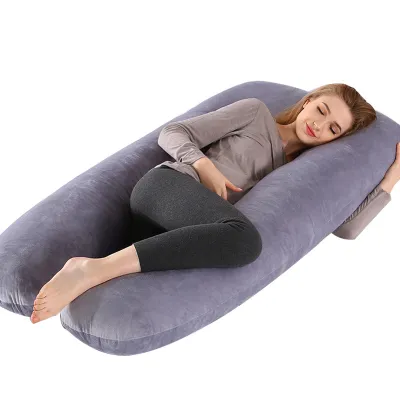
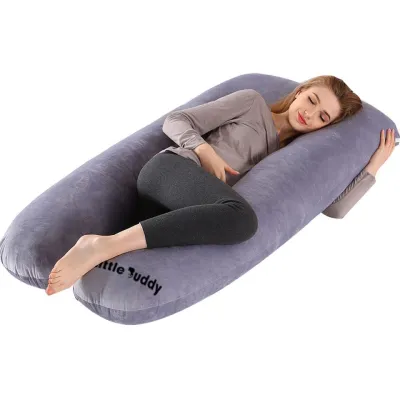
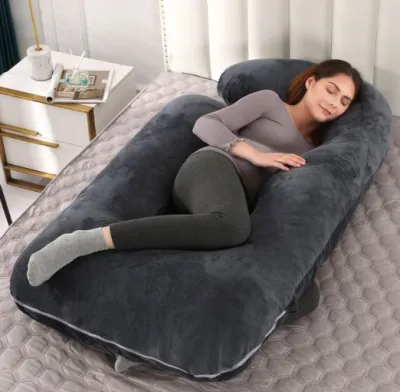
The U-shaped pregnancy pillow is a large, symmetrical cushion designed to wrap completely around your body, resembling a giant horseshoe. To use it, you lie directly in the center of the “U,” resting your head on the curved top portion while the two long legs of the pillow run down your front and back. This design provides equal, simultaneous support to your head, neck, spine, belly, hips, and knees without requiring you to adjust the pillow when you change sides.
Products mentioned in this guide
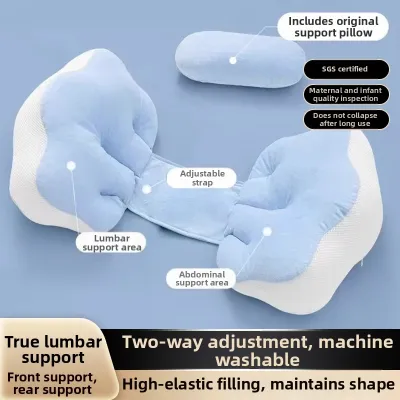

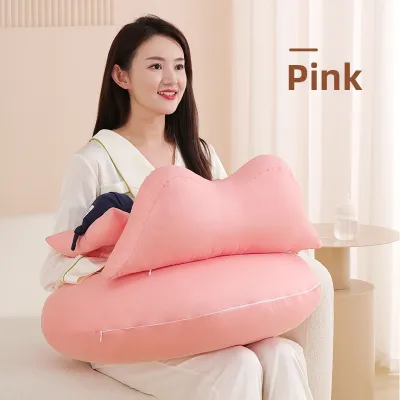
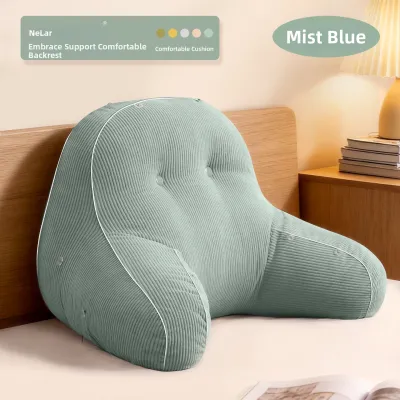
Prices are valid at publication and may change. Please refer to the product page for the latest price.
One of the primary benefits of this shape is its unmatched support for active sleepers. If you find yourself turning from your left side to your right side throughout the night, you can simply roll over within the center of the pillow. The front leg of the “U” will support your belly, while the back leg supports your spine, regardless of which way you face. This continuous alignment helps keep your hips stacked, reducing pelvic girdle pain and lower back strain by preventing the upper leg from twisting forward over the lower leg.
However, the substantial size of a U-shaped pillow is its main limitation. These pillows occupy a massive footprint on the mattress, which can easily crowd a standard double or queen-sized bed. If you share a bed with a partner, they may find themselves pushed to the outer edge of the mattress. Additionally, the sheer volume of fabric and filling can trap body heat, which is an important factor to consider during warm, humid nights in the tropical climate of the Philippines.
C-Shaped Pregnancy Pillows: Targeted Side Support
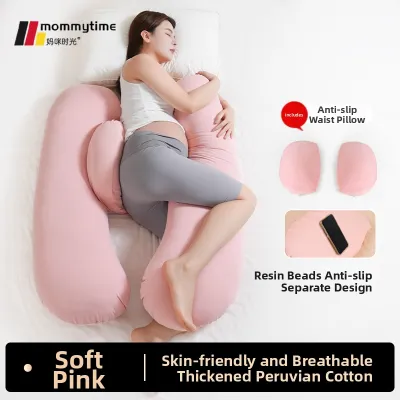
The C-shaped pregnancy pillow is a curved, hook-like cushion designed to support one side of your body. When using a C-shaped pillow, you place your head on the top curve of the “C,” tuck the middle section along your back or under your belly, and place the bottom curve between your thighs or knees. This configuration helps align your spine and pelvic area, reducing the forward-pulling pressure of a growing belly on your lower back.
A major benefit of the C-shaped design is its ability to offer comprehensive, head-to-toe support while taking up significantly less bed width than a U-shaped alternative. It leaves one side of your body completely open, making it much easier to climb in and out of bed for those frequent nighttime bathroom trips. This open design also allows for better airflow, helping you stay cooler than a fully enclosed U-shaped model.
The primary drawback of the C-shaped pillow is that it is asymmetrical in its support. If you decide to roll over to face the opposite direction during the night, you must physically drag the entire pillow with you to maintain front-of-body support. This movement can disrupt your sleep cycle and require some physical effort, which becomes increasingly difficult as your pregnancy progresses into the third trimester.
Wedge Pregnancy Pillows: Compact and Focused Relief
Wedge pregnancy pillows are small, triangular or sloped cushions made of firm foam or dense fiberfill. Unlike full-body pillows, wedges do not attempt to support your entire body at once. Instead, they are designed for targeted, localized relief. You can slide the thin edge of the wedge under your belly while side-sleeping to gently lift and support the weight, or place it behind your lower back to prevent you from rolling onto your spine during sleep.
The most significant advantage of a wedge pillow is its compact size and high portability. It takes up virtually no space in the bed, making it an excellent choice for smaller mattresses or co-sleeping setups where bed space is at a premium. It is also incredibly easy to pack in a suitcase for travel or move to the living room sofa for extra lumbar support while sitting. Because they are smaller, wedge pillows are generally the most affordable option, often costing a fraction of the price of full-body pillows.
On the other hand, a wedge pillow cannot provide head, neck, or knee support on its own. If you suffer from hip pain or joint misalignment, you will need to pair the wedge with standard bed pillows to keep your knees separated and your spine straight. It is a minimalist tool rather than an all-in-one sleep system.
Head-to-Head Comparison: Space, Support, and Versatility
Bed Footprint and Space
When choosing a pregnancy pillow, mattress size is often the deciding factor. A U-shaped pillow requires a Queen or King-sized mattress to coexist comfortably with a partner. In smaller bedroom configurations common in many urban Philippine homes, a U-shaped pillow can make the bed feel incredibly cramped. C-shaped pillows offer a more balanced footprint, fitting comfortably on standard Double or Queen beds while still leaving room for another person. Wedge pillows are the ultimate space-savers, requiring no extra mattress width and allowing you to maintain your usual sleeping setup without disruption.

Support Coverage
If you experience widespread aches, joint pain, or pelvic pressure, full-body support is crucial. U-shaped and C-shaped pillows excel here by providing continuous alignment from your head down to your ankles. Placing a thick pillow between your knees is essential for keeping your hips level, which directly relieves pressure on the sacroiliac (SI) joints. A wedge pillow, while highly effective for relieving the downward pull on your belly or supporting your lower back, cannot address hip or shoulder misalignment unless supplemented with other pillows.
Adjustability and Postpartum Use
Investing in a pregnancy pillow is more practical when the item serves multiple purposes. Both U-shaped and C-shaped pillows offer excellent versatility; they can be folded, twisted, or coiled to support you while sitting up in bed to read or watch television. Postpartum, these large pillows can be repurposed as nursing supports, wrapping around your waist to help hold your baby at the correct height during breastfeeding or bottle-feeding. Wedge pillows also transition well into the postpartum period, serving as comfortable lumbar support in office chairs or as a gentle incline pillow to help manage acid reflux.
Comparison Table
| Feature | U-Shaped Pillow | C-Shaped Pillow | Wedge Pillow |
|---|---|---|---|
| Space Required | High (Queen or King bed recommended) | Moderate (Fits Double or Queen beds) | Very Low (Fits any bed size) |
| Primary Support Areas | Head, neck, back, belly, hips, and knees | Head, back or belly, knees, and ankles | Localized (Belly lift or back support) |
| Portability | Low (Bulky and difficult to travel with) | Medium (Can be compressed slightly) | High (Lightweight and travel-friendly) |
| Postpartum Use | Nursing support, sitting prop, body barrier | Nursing support, sitting prop | Lumbar support, leg elevation, reflux relief |
| Best For | Active sleepers who toss and turn | Side sleepers wanting full-body alignment | Hot sleepers, small beds, and travelers |
Best Pillow Shapes for Specific Sleeping Positions and Scenarios
Strict Side Sleepers
Medical professionals generally recommend side sleeping—particularly on the left side—during later pregnancy because it keeps the heavy uterus from pressing on the inferior vena cava, the large vein that carries blood back to your heart. For strict side sleepers, a C-shaped or U-shaped pillow is highly beneficial. These shapes fill the gap between your waist and the mattress, preventing your torso from twisting forward. By keeping your shoulders, hips, and knees in a straight line, these pillows eliminate the morning stiffness and hip soreness that many expectant mothers experience.
Back Sleepers Transitioning to Side Sleeping
If you are a natural back sleeper, training yourself to sleep on your side can be incredibly difficult. During deep sleep, your body will naturally try to return to its habitual position. A wedge pillow is an excellent, low-profile tool to prevent this. By placing the steep side of the wedge firmly against your lower back, you create a physical barrier that prevents you from rolling flat onto your back. Alternatively, a U-shaped pillow provides a secure, nested feeling that physically restricts your movement, keeping you safely positioned on your side throughout the night.
Small Beds and Co-Sleeping Partners
In many households, sleeping arrangements involve sharing a bed with a partner, older children, or pets. Introducing a massive full-body pillow into a shared bed can lead to poor sleep quality for everyone involved. In these situations, a wedge pillow is the most practical solution. It provides the necessary belly support without creating a physical wall between you and your partner. If you still require knee support, a simple, standard bed pillow placed between your thighs takes up far less room than a full-sized U-shaped model.
Climate and Comfort Considerations
The tropical climate of the Philippines presents a unique challenge for pregnant sleepers. High humidity and elevated temperatures mean that sleeping surrounded by thick, synthetic fabrics can lead to overheating, night sweats, and skin irritation. When shopping for a pregnancy pillow, always verify the product specifications for a breathable, removable, and washable cover. Natural fibers such as cotton, bamboo-derived rayon, or linen are highly recommended because they allow heat to dissipate and absorb moisture far better than polyester blends.
Final Decision Framework: Which One Should You Buy?
Choose a U-Shaped Pillow if:
- You sleep on a Queen or King-sized bed and have ample space.
- You frequently toss, turn, and switch sides throughout the night.
- You want complete, symmetrical support for both your back and your belly without moving the pillow.
Choose a C-Shaped Pillow if:
- You want comprehensive head-to-toe support but sleep on a Double or Queen bed.
- You prefer having one side of your body open for easy movement and better airflow.
- You do not mind occasionally shifting the pillow when you roll over.
Choose a Wedge Pillow if:
- You have limited bed space, share your bed, or travel frequently.
- You only experience localized discomfort, such as a pulling sensation in your belly or lower back strain.
- You prefer using your own familiar bed pillows for head and neck support.
- You are looking for a highly budget-friendly option.
Verify First if:
Before making a final purchase, check the physical dimensions of the pillow against your mattress size to ensure a proper fit. If you experience severe pelvic girdle pain, sciatica, or other pre-existing orthopedic conditions, consult your obstetrician or a physical therapist. They can provide professional guidance on the exact pillow placement and support level required for your specific physical needs.
Frequently Asked Questions (FAQ)
When is the best time to start using a pregnancy pillow?
There is no strict calendar rule for when you must start using a pregnancy pillow, as every pregnancy develops differently. However, many expectant mothers find them highly beneficial starting around the second trimester, typically between weeks 12 and 16. This is when the abdomen begins to expand, making comfortable side-sleeping more difficult. You do not need to wait for chronic back or hip pain to develop; introducing a supportive pillow early can help prevent sleep-disrupting aches before they begin.
Can I just use regular bed pillows instead of a dedicated pregnancy pillow?
You can certainly use standard bed pillows to create a custom support system. Placing one pillow under your head, another between your knees, and a rolled-up towel under your belly can provide temporary relief. However, loose bed pillows tend to slide around, flatten quickly under heavy pressure, and require constant manual readjustment every time you shift positions. Dedicated pregnancy pillows are specifically contoured to stay securely in place and maintain the correct ergonomic angles throughout the night, offering a much more seamless sleep experience.
How do I clean and maintain a full-body pregnancy pillow?
Always check the manufacturer’s care label on your specific pillow before cleaning. Generally, you should look for pregnancy pillows that feature a zippered, removable cover that can be machine-washed on a gentle cycle with mild detergent. The inner filling of full-body pillows is usually not machine-washable, as the agitation can cause the stuffing to clump or lose its shape. To maintain the inner cushion, spot-clean any stains with a damp cloth and mild soap, then allow it to air dry completely in a well-ventilated area away from direct sunlight to prevent mold or mildew growth.

Community discussion
Share your experience or ask a question. Comments are reviewed before publication.