
Setting up a nursery in a compact bedroom requires a thoughtful balance of spatial efficiency, daily functionality, and safety. When floor space is at a premium, finding the right infant bed and changing table setup is not simply a matter of choosing the smallest items on the market. Instead, it involves selecting a configuration that maximizes vertical space, maintains clear pathways for caregivers, and adapts seamlessly to your growing baby’s developmental stages. In tropical climates like the Philippines, where high humidity and temperature regulation are constant considerations, the way you arrange and select your nursery furniture also directly impacts your baby’s comfort and sleep quality. By focusing on smart layouts and multi-functional designs, you can create a serene, organized, and highly functional space that supports your daily parenting routines without making your bedroom feel cramped.
Assessing Your Nursery Space and Clearances
Before you begin browsing online marketplaces or visiting local furniture showrooms, it is essential to map out the exact physical dimensions of your shared or dedicated bedroom. Start by measuring the length and width of the room using a reliable tape measure, noting the precise locations of architectural features such as windows, electrical outlets, light switches, and air conditioning units. It is a common mistake to measure only the open wall space while overlooking how doors, closet doors, and dresser drawers swing open. To prevent frustrating physical blocks, map out the full arc of every door and drawer in the room to ensure they can open completely without colliding with your baby’s sleeping or changing area.
Beyond the static footprint of the furniture, you must account for active clearance zones—the space required for you to move and care for your baby comfortably. An infant bed requires sufficient clearance around at least one long side so you can easily lower your baby to sleep and lift them up without straining your back or bumping into adjacent walls. For the diaper changing area, you will need a dedicated standing zone of at least 60 to 90 centimeters directly in front of the changing surface. This space allows you to stand squarely, move your arms freely, and react quickly if your baby wiggles, all without feeling restricted by nearby walls or furniture.
Products mentioned in this guide
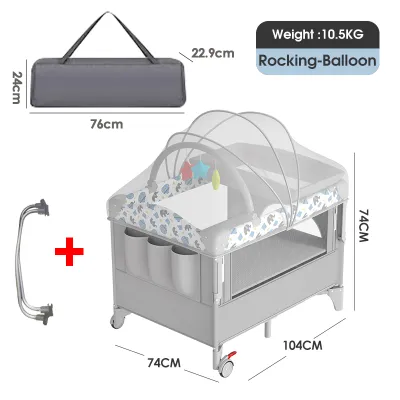
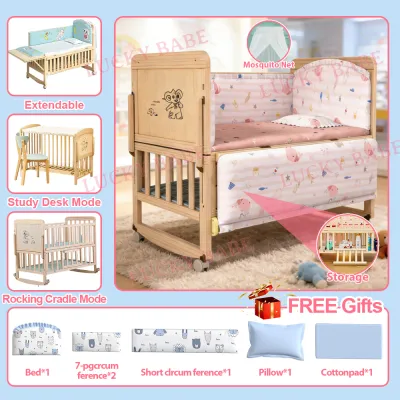
Prices are valid at publication and may change. Please refer to the product page for the latest price.
Once you have these measurements, compare the total footprint and height of your prospective furniture sets against the room’s net clearances. In smaller rooms, utilizing vertical space is highly effective, but you must ensure that tall shelving, high crib arches, or integrated changing toppers do not block natural ventilation pathways or sit directly beneath air conditioning vents. A highly practical way to visualize this is by using painter’s tape to outline the exact dimensions of the infant bed and changing table on your bedroom floor. This simple step allows you to physically walk through the room and experience the flow of the space before making any financial commitments.
Evaluating Compact Infant Bed and Changing Table Configurations
Integrated furniture sets are an excellent solution for tight spaces, typically featuring an infant bed with a changing table attached directly to the side or footboard. This unified design eliminates the dead space that naturally occurs between separate pieces of furniture, saving valuable centimeters of floor space. Many of these integrated units are designed with built-in drawers or shelving directly beneath the changing surface, allowing you to store diapers, wipes, and clothing in a single, compact footprint. This configuration keeps all your essential supplies within arm’s reach, streamlining your workflow during late-night diaper changes.

If your bedroom has an irregular layout, such as alcoves, narrow niches, or angled walls, standalone compact furniture may offer better flexibility than a single large unit. You can pair a compact infant bed—such as a mini-crib with built-in under-crib storage drawers—with a separate foldable or wall-mounted changing station. Under-crib storage is highly efficient for keeping extra bed sheets, swaddles, and seasonal clothing out of sight without taking up additional floor space. Meanwhile, a foldable changing table can be set up quickly for diaper changes and then folded flat and stored against a wall or inside a closet when not in use, keeping the room feeling open and uncluttered.
Another highly practical strategy for small bedrooms is investing in convertible furniture combinations that grow alongside your child. Some high-quality systems are designed to transition from an infant bed with an attached changing table into a toddler bed, daybed, or even a full-sized bed, while the changing unit detaches to become a standalone nightstand or chest of drawers. While these convertible systems may require a slightly higher initial investment, they eliminate the need to purchase entirely new furniture sets as your baby reaches new developmental milestones. Evaluating how these pieces transition and ensuring you have a plan to store any conversion kits or extra parts is key to maximizing your long-term space savings.
Essential Safety and Functionality Checks for Compact Furniture
When prioritizing space-saving designs, safety must always remain your primary focus, and you should never compromise on structural integrity for the sake of a smaller footprint. Always verify the manufacturer’s stated age, weight, and height limits in the product documentation to ensure the furniture is appropriate for your baby’s current developmental stage. Additionally, inspect the product labels to verify recognized safety certification marks, which indicate that the furniture has undergone rigorous testing for stability, material safety, and structural strength. Because safety standards are dynamic, it is also wise to check for any recent manufacturer recalls before assembling or using any nursery furniture.
Pay close attention to the physical design details of both the changing table and the infant bed to prevent common hazards. The changing table must feature secure, sturdy guardrails on all sides with an anti-fall design, and the changing pad should be securely fastened to the wooden frame with safety straps. For the infant bed, verify that the slat spacing is no wider than 6 centimeters to prevent any risk of your baby’s head or limbs becoming trapped. Ensure that the mattress fits snugly against the crib frame; there should be no gaps wider than two fingers between the mattress and the sides of the bed, as gaps can pose a serious suffocation or entrapment hazard.
Daily usability relies heavily on how easily you can access your supplies while keeping your baby secure. When diapering an infant, you must maintain physical contact with your baby at all times—keeping one hand on them to prevent sudden rolls or falls. Test the accessibility of the storage compartments on your chosen furniture set to ensure you can smoothly retrieve diapers, wipes, and fresh clothes with your free hand without having to stretch, bend over, or step away from the changing surface. If a drawer is difficult to open or a shelf is positioned too low, it can disrupt this safe workflow and increase the risk of accidents.
Common Space-Planning Mistakes to Avoid
One of the most frequent mistakes in small bedrooms is placing the infant bed too close to windows, air conditioning units, or wall decorations. In warm, humid climates, positioning the bed directly under an air conditioning unit or in a stagnant corner can compromise ventilation and temperature regulation, which are crucial for preventing overheating. Keep the bed away from windows to avoid hazards like direct sunlight, drafts, and dangling cords from blinds or curtains, which pose a severe strangulation risk. Additionally, ensure that no heavy wall art, shelving, or electrical cords are within reach of the crib, as babies will eventually learn to pull themselves up and grab nearby objects.
It is also easy to fall into the trap of prioritizing excessive multi-functionality over structural stability. A piece of furniture that tries to do too many things—such as folding, sliding, converting, and rolling all at once—may suffer from wobbly joints, loose hardware, or cumbersome mechanisms. In a humid environment, wood can expand and contract, which may cause complex moving parts to stick or wear out prematurely. Prioritize solid construction, robust hardware, and stable frames over complex, multi-folding features that might compromise the safety and longevity of the furniture.
Finally, remember to plan for your baby’s future mobility milestones. Babies grow and develop rapidly, and a tight furniture layout that works perfectly for a stationary newborn can quickly become restrictive once your baby starts rolling, crawling, or pulling themselves up to stand. Avoid filling every square centimeter of floor space with furniture; instead, reserve a clear, safe area on the floor where your baby can practice these essential physical milestones. Keeping the center of the room open not only supports your baby’s physical development but also makes the bedroom feel much more spacious and easier to clean.
Frequently Asked Questions (FAQ)
Can I use a regular dresser as a changing table in a small room?
Yes, repurposing a sturdy, low-profile dresser as a changing station is a highly effective space-saving technique for compact bedrooms. However, you must take critical safety precautions to ensure it is safe for daily use. First, you must install a heavy-duty anti-tip kit to securely anchor the dresser to the wall studs, preventing it from tipping over when drawers are pulled out or when weight is applied to the top. Additionally, verify that the dresser’s top surface is wide and deep enough to accommodate a standard changing pad securely, ensuring the pad is fastened down and does not overhang the edges.
Are fold-down wall changing tables safe for everyday use?
Fold-down wall changing tables can be safe and highly practical for small rooms, provided they are installed with absolute precision and used under strict caregiver supervision. You must strictly follow the manufacturer’s instructions and mount the unit exclusively onto solid wall studs or load-bearing walls, as standard drywall alone cannot support the weight of the table and a growing baby. Establish a routine to inspect the hinges, mounting screws, and locking mechanisms regularly to ensure the unit remains structurally sound, and always keep one hand on your baby during use.

Community discussion
Share your experience or ask a question. Comments are reviewed before publication.