
Choosing the right baby walker trainer for your child is not a matter of finding a single, universally superior product. Instead, the decision depends entirely on your baby’s current physical milestones, the layout of your home, and your ability to provide uninterrupted supervision. Seated walkers offer supported mobility for infants who can sit upright but require strict environmental controls to prevent tipping and stair-fall hazards. Conversely, push-along walkers are designed for babies who are already pulling themselves up to stand, focusing on active balance and leg strength. By evaluating how each walker type aligns with your child’s development and your living space, you can select an aid that supports their physical progress safely.
Both types of walkers serve as temporary activity and mobility aids rather than tools that independently teach a child how to walk. Understanding the mechanical and developmental differences between them is the first step in making an informed purchase.
Understanding Seated and Push-Along Baby Walkers
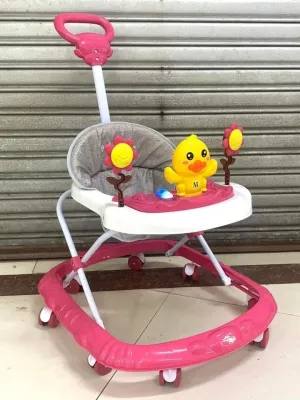
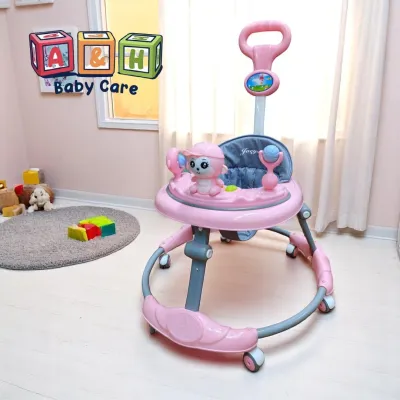
Seated baby walkers consist of a suspended fabric seat positioned inside a rigid plastic or metal frame equipped with wheels. The design allows a baby to sit upright with their legs dangling through the seat openings, enabling them to propel themselves across the floor using their toes and feet. Because the frame supports the baby’s weight, it provides a sense of independent mobility before the child’s leg muscles and balance are fully developed for independent standing.
Products mentioned in this guide
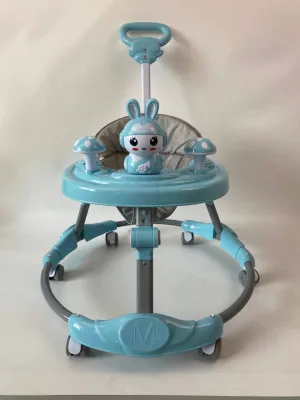
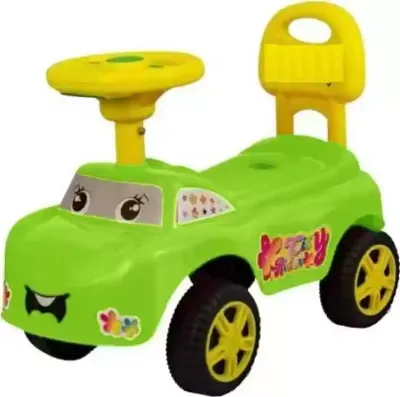
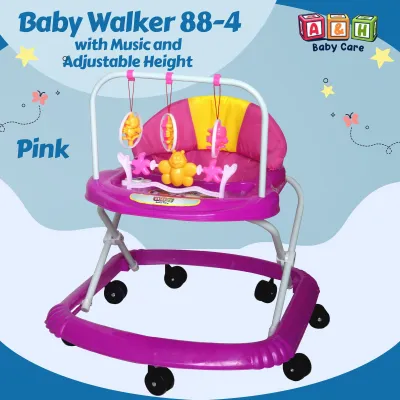
Prices are valid at publication and may change. Please refer to the product page for the latest price.
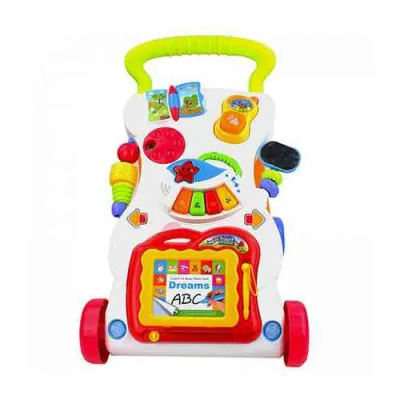
Push-along walkers, often referred to as push toys or toddler walkers, are upright wheeled structures featuring a handle that the baby grips from behind. These devices do not have a seat; instead, the baby must stand on their own feet and push the toy forward to move. They are designed to roll forward as the baby walks, acting as a moving support system that requires the child to actively engage their core, legs, and balance mechanisms.
It is important to recognize the core trade-off between these two designs. A seated walker provides artificial support that keeps a baby upright without requiring them to balance themselves, which can sometimes lead to improper foot positioning, such as walking exclusively on tiptoes. A push-along walker requires the baby to bear their own weight and maintain balance, meaning it cannot be used until the baby has reached specific standing milestones. Neither device accelerates the natural timeline of independent walking, but they offer different ways for your baby to explore their environment.
Developmental Readiness and Safety Boundaries
Before introducing any baby walker trainer, you must verify your child’s current developmental stage against the manufacturer’s guidelines. For a seated walker, the baby must be able to hold their head up steadily and sit unassisted without leaning. You must stop using a seated walker immediately once your baby can walk independently, or when they reach the maximum weight or height limits specified in the product manual.

For a push-along walker, the physical prerequisites are more advanced. Your baby must be able to pull themselves up to a standing position using furniture and bear their full weight on their legs. They should also demonstrate basic trunk control and the ability to take tentative steps while holding onto support. If a baby cannot yet stand or balance, a push-along walker will simply roll away from them, leading to falls.
Safety boundaries differ significantly between the two types. Seated walkers carry a high risk of stair falls and tipping if a wheel catches on an obstacle. Because babies can move exceptionally fast in a seated walker, they can quickly reach hazards like hot surfaces, electrical cords, or household chemicals. Push-along walkers present a different safety challenge; if the wheels roll too quickly on smooth floors, the walker can slide out from under the baby. To mitigate this, look for push-along models that feature adjustable wheel resistance or friction strips to control the rolling speed.
Evaluating Your Home Environment and Flooring
Your living space plays a critical role in determining which walker type is practical and safe. Seated walkers require a wide, flat, and completely level area with a generous turning radius. Because the frames are wide, they can easily get stuck in narrow doorways or cluttered hallways, which can frustrate your baby or cause the device to tip.
Push-along walkers require straight, unobstructed pathways where your baby can push the toy forward without colliding with furniture. In many tropical homes, flooring consists of smooth ceramic tiles, polished concrete, or hardwood. These smooth surfaces can cause push-along wheels to slide too quickly, especially if the baby is barefoot or wearing slick socks. Verify that the wheels of a push-along walker are made of slip-resistant materials, such as rubber or textured plastic, or feature adjustable tension settings to prevent sudden slips.
Regardless of the walker type, you must conduct a thorough hazard assessment of your home. Identify any steps, raised door thresholds, loose rugs, or floor transitions that could catch a wheel and cause a tip-over. Ensure that low tables, countertops, and shelves are cleared of heavy objects, hot liquids, or small items that your baby could reach now that they are elevated in a walker. Remember that baby gates must be securely installed at the top and bottom of all stairways to prevent catastrophic falls.
Key Features to Compare and Verify Before Buying
When shopping for a baby walker trainer, comparing physical specifications and safety features is essential. Use the following comparison table as a starting point to evaluate the general characteristics of each type:
| Feature | Seated Baby Walker | Push-Along Baby Walker |
|---|---|---|
| Prerequisite Milestone | Sitting unassisted with steady head control | Pulling to stand and bearing full weight |
| Primary Movement | Toe-propelling while supported in a seat | Upright walking while pushing from behind |
| Wheel Resistance | Typically free-rolling; some models have locks | Often adjustable or features friction pads |
| Base Design | Wide, enclosed plastic or metal frame | Open back with a weighted front base |
| Typical Weight Limit | Refer to manual (often up to 11–12 kg) | Refer to manual (varies by toy design) |
If you are considering a seated walker, prioritize seat ergonomics. The fabric seat should be padded, washable, and offer adjustable height settings so you can ensure your baby’s feet touch the floor correctly according to the manufacturer’s instructions. The leg openings must be smooth and wide enough to prevent skin chafing or pinching, while the base of the walker should be significantly wider than the top frame to provide stability.
For push-along walkers, base stability is the most critical factor. The handle should be at a comfortable height that allows your baby to stand upright without hunching over. Look for a wide wheel base and a weighted front design, which helps prevent the walker from tipping backward when your baby pulls themselves up using the handle. Some models allow you to add weight, such as water or sand, to the toy’s body to increase stability during the early stages of standing.
Many walkers of both types feature integrated activity panels with toys, music, or lights. While these can keep your baby entertained, verify that the toys are securely attached and do not feature small parts that could pose a choking hazard. Ensure there are no pinch points where tiny fingers could get caught, and check that the activity panel does not distract your baby from maintaining their balance or navigating their path safely.
Making the Final Decision for Your Baby
To make the final decision, assess your baby’s current physical abilities alongside your home’s layout. A seated walker may be suitable if your baby can sit independently but cannot yet stand, provided you have a spacious, single-level home with flat floors, no steps, and you can guarantee constant, active adult supervision. You must remain within arm’s reach of the baby at all times while they are in a seated walker.
Choose a push-along walker if your baby is already pulling themselves up to stand, is eager to take assisted steps, and needs to practice balance and coordination. This option is ideal if you have clear, straight pathways in your home and want a toy that transitions into a toddler plaything once your child walks independently.
Skip both options if your baby shows no interest in upright mobility, if your home has multiple floor levels, steps, or cluttered spaces that cannot be easily cleared, or if you cannot provide undivided adult supervision. In these cases, traditional floor play, supervised tummy time, and allowing your baby to pull themselves up on sturdy, stationary household furniture are highly effective, safe, and free methods to support their natural motor development.
Frequently Asked Questions (FAQ)
Do pediatricians recommend using baby walkers?
Many pediatric associations and healthcare professionals worldwide advise against the use of traditional seated baby walkers. The primary concern is safety, as these devices allow babies to move at high speeds and reach hazards—such as stairs, hot surfaces, and toxic substances—much faster than caregivers can react. Additionally, developmental experts note that seated walkers do not help babies learn to walk sooner and can sometimes encourage improper walking posture, such as toe-walking. Always consult your pediatrician or a qualified healthcare professional to discuss your baby’s motor development and to identify safe mobility alternatives.
What are safe alternatives to traditional baby walkers?
If you choose not to use a mobile baby walker trainer, several stationary alternatives support your baby’s development without the associated mobility risks. Stationary activity centers (often called exersaucers) allow your baby to stand, bounce, and play with toys in a fixed location, though usage should still be limited to short intervals. Sturdy playpens, large play mats, and dedicated floor time are excellent for encouraging natural rolling, crawling, and pulling up. Before introducing any alternative gear, always verify the manufacturer’s age, weight, and developmental guidelines, and ensure an adult is supervising the play area.

Community discussion
Share your experience or ask a question. Comments are reviewed before publication.