
Finding the ideal joie baby swing requires balancing your baby’s physical development with your home’s layout. Because infants grow rapidly and home environments vary—from compact urban condominiums to spacious provincial houses—the right choice depends on a careful evaluation of age suitability, structural footprint, and daily lifestyle needs. By focusing on these core dimensions, you can select a model that keeps your baby secure and comfortable while integrating seamlessly into your living space.
Quick Guide: Matching a Joie Baby Swing to Age and Space
Selecting a baby swing is not a one-size-fits-all decision, as your child’s physical growth and your home’s layout dictate which model is most appropriate. Joie offers several categories of swings designed to meet different needs. These range from compact, lightweight models that fold for easy storage to versatile 2-in-1 bouncer and swing combinations, and robust, full-size multi-directional swings that serve as dedicated soothing stations. Each category addresses specific developmental milestones and space constraints, making it essential to evaluate your household’s unique situation before purchasing.
The core age rule centers on physical support and safety. Newborns have very weak neck muscles and require a deep, near-flat recline along with specialized head support to keep their airways open. As infants grow, gain head control, and become more curious, they require more upright seating positions and higher weight capacities. Matching the swing to your baby’s developmental stage ensures they remain safely positioned and comfortable during use.
Products mentioned in this guide
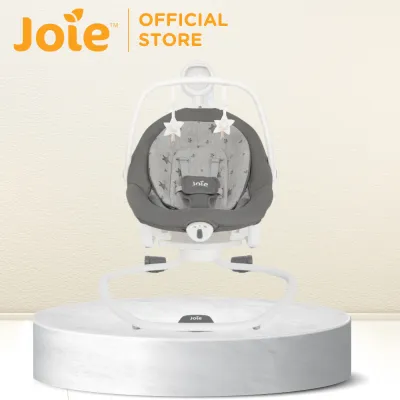
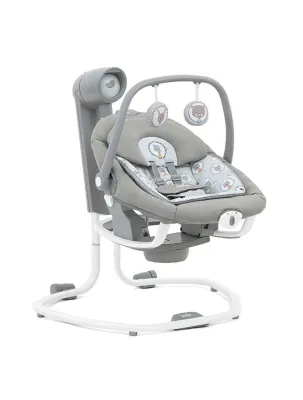
Prices are valid at publication and may change. Please refer to the product page for the latest price.
Space is the other critical factor in this decision. For families living in compact apartments or urban condominiums, a foldable frame or a dual-function 2-in-1 unit is often the most practical choice because it minimizes floor clutter. Conversely, larger homes with dedicated nurseries or spacious living areas can comfortably accommodate full-size, plug-in models that remain stationary. Regardless of which model you choose, you must always verify the exact weight limits, dimensions, and age recommendations on the specific product’s official label or user manual before making your final purchase.
Choosing by Age: Newborn Needs vs. Older Infant Support
A baby’s developmental stage is the most critical factor when choosing a swing. Because infants undergo rapid physical changes in their first year, a swing that is perfect for a two-week-old newborn may not be safe or comfortable for a six-month-old infant. Understanding these developmental milestones helps you choose a model that provides the right level of support and security at every stage.

Newborn Stage (Recline and Head Support)
During the first few months of life, newborns lack the muscle strength to support their own heads. For this reason, a deep, near-flat recline position is absolutely vital. If a newborn is placed in a seat that is too upright, their head can tilt forward onto their chest, which can restrict their sensitive airway and lead to positional asphyxiation. When evaluating Joie swings, look for models that offer multiple recline angles, ensuring you can lock the seat into a fully reclined position suitable for the youngest babies.
In addition to a deep recline, adequate head and neck support is essential for newborns. Many Joie models include removable infant inserts or body cushions specifically designed to cradle smaller babies and keep them centered in the seat. These inserts prevent the baby’s head from slumping to the side. Always verify the manufacturer’s minimum weight and age guidelines before placing your newborn in the swing. Some models are designed for babies starting at birth (around 3 kilograms), while others may have higher minimum weight requirements.
Security is another paramount concern for newborns. A secure multi-point harness—typically a 5-point harness system—is necessary to keep tiny babies safely positioned. The harness should fit snugly over the shoulders, around the waist, and between the legs, preventing the baby from sliding down or shifting to an unsafe angle. Before every use, adjust the harness straps to fit your newborn’s current size, especially as they wear different types of clothing.
Older Infants (Upright Positions and Weight Limits)
As babies grow, they develop strong head control and become highly interested in their surroundings. Around three to four months of age, most infants no longer want to lie flat; they prefer more upright seating positions that allow them to look around, track your movements, and interact with their environment. A swing with adjustable recline positions allows you to transition the seat to a more upright angle as your baby’s physical capabilities progress.
However, as your baby grows, you must constantly monitor the swing’s maximum weight and height limits. Most standard infant swings are designed to support babies up to approximately 9 to 13 kilograms, but these limits vary significantly by model. You can find these exact specifications printed on the product label or inside the user manual. Exceeding these limits can strain the motor, compromise the frame’s stability, and create a serious safety hazard.
Increased mobility brings new safety challenges. Once babies become more active, they may attempt to roll, lean heavily to one side, or even try to climb out of the swing. At this stage, the swing’s structural stability and the security of the harness become even more critical. A wider base helps prevent the swing from tipping when the baby moves dynamically.
You must transition your baby out of the swing permanently once they reach the manufacturer’s stated developmental limits. Typically, this means stopping use immediately when the baby can sit up unassisted, attempts to climb out, or reaches the maximum weight capacity. Continuing to use the swing past these milestones increases the risk of falls and structural failure.
Choosing by Space: Compact Apartments vs. Multi-Room Homes
Your home’s layout and available floor space play a major role in determining which Joie swing model is practical for your daily routine. A swing that is too large can turn a living room into a tripping hazard, while a swing that is too small might lack the features you need for long-term comfort. Assessing your living space helps you find the right balance between functionality and footprint.
Compact and Foldable Options for Small Spaces
For families living in compact apartments, urban condominiums, or homes with limited floor space, space-saving designs are essential. One of the most efficient solutions is a 2-in-1 model that converts from a stationary bouncer or rocker to a full swing. In these designs, the seat can be detached from the main swing frame, allowing you to use it as a lightweight, portable bouncer that you can easily carry from room to room. This dual functionality eliminates the need to purchase and store two separate, bulky pieces of baby gear, saving both space and money.
Another excellent feature for small spaces is a foldable frame. Some compact Joie swings are engineered with slim frames that fold flat or collapse down. This allows you to tuck the swing away into a closet, behind a sofa, or against a wall when it is not in use, keeping your living areas clear. Before buying, it is wise to measure your intended floor space and compare it against the product’s listed footprint dimensions, both when fully assembled and when folded, to ensure a proper fit.
Compact models also offer advantages in terms of power and placement. Many smaller, portable swings can operate on battery power or feature rechargeable options. This cordless functionality means you do not have to position the swing near a wall outlet, giving you the freedom to place it in the safest, most convenient spot in the room without creating a tripping hazard with power cords. This is particularly useful in older homes or open-plan layouts where electrical outlets may be sparse.
Full-Size and Multi-Direction Models for Larger Rooms
If you live in a larger home with a dedicated nursery, a spacious living room, or multiple rooms where you can leave a swing permanently set up, a full-size model may be the ideal choice. These larger swings often feature advanced motion capabilities, such as multi-directional swaying. Instead of simply moving front-to-back, these models can sway side-to-side or combine motions into a soothing figure-eight pattern. To support these complex movements safely, full-size swings are built with a wider, heavier base that prevents tipping, requiring a larger dedicated footprint on your floor.
A major benefit of full-size models is the convenience of direct plug-in power options. Because these swings are designed to remain stationary, they can be plugged directly into a standard 220V electrical outlet (common in the Philippines). This eliminates the ongoing expense and hassle of purchasing and replacing heavy-duty batteries, which can drain quickly with frequent use. Plug-in models provide consistent, uninterrupted power to the swing’s motor and electronic features.
While full-size swings occupy more floor space, they compensate by offering a wider array of integrated features. These can include larger, adjustable canopies to block out bright indoor light, overhead toy bars with plush hanging toys, and more spacious, deeply padded seats that accommodate growing babies comfortably. Some models even feature integrated nightlights or vibration settings built into the seat itself.
When setting up a full-size swing, you must ensure there is adequate clearance around the entire unit. The swing should be placed away from walls, furniture, low-hanging decorations, and high-traffic walkways. There must be enough open space around the swing so that even at its highest speed setting, the seat never makes contact with any surrounding objects, ensuring your baby’s safety at all times.
Essential Features to Check Before You Buy
Beyond age and space considerations, several key features can greatly influence how convenient a swing is for you to use and how comforting it is for your baby. Comparing these features across different Joie models will help you narrow down your choices to the perfect match.
Motion and Speed Settings
Babies have distinct preferences when it comes to motion. Some are easily soothed by a gentle, barely-perceptible sway, while others respond better to a faster, more rhythmic motion. Most Joie swings come equipped with multiple speed settings—often ranging from slow and gentle to more active paces. Having a variety of speeds allows you to adjust the motion to suit your baby’s changing moods. Additionally, some models offer different motion patterns, such as gliding, swaying, or bouncing, giving you more options to find what comforts your child best.
Sound and Entertainment
Many Joie swings feature integrated sound machines that play a variety of melodies, lullabies, or soothing white noise and nature sounds. These auditory features can help mask household noise and create a calming environment for your baby. Some models also include overhead toy bars or rotating mobiles with soft toys to provide visual stimulation and encourage eye-tracking. When choosing a model, verify if the sound and entertainment features require separate batteries or if they run on the main power source, and check if the volume is adjustable to suit your home’s noise levels.
Seat Cover and Hygiene
In the warm and humid tropical climate of the Philippines, keeping baby gear clean is a top priority. Babies sweat, spit up, and are prone to occasional diaper leaks, making a hygienic seating surface essential. Look for Joie models that feature easily removable, machine-washable seat covers. Before washing, always consult the care label attached to the fabric for specific instructions. Generally, washing on a gentle cycle with a mild, baby-safe detergent and allowing the cover to air dry is the best way to prevent shrinkage and maintain the integrity of the harness slots.
Power Source
Consider how and where you plan to use the swing when evaluating its power options. Models that offer dual power sources—allowing you to plug into a wall outlet or use batteries—provide the greatest flexibility. If you plan to keep the swing in a fixed location near an outlet, using AC power is highly cost-effective and environmentally friendly. However, if you want the freedom to move the swing outdoors onto a shaded patio or into a room without nearby outlets, battery power is incredibly convenient.
Portability and Handles
If you need to move the swing around your home frequently to keep an eye on your baby while you complete household chores, portability is key. Some Joie swings are designed with integrated carry handles and lightweight frames, making them easy to lift and carry with one hand. Other larger models may feature integrated wheels on one side of the frame, allowing you to tilt and roll the swing from room to room without lifting the entire weight of the unit.
Safety Rules and Knowing When to Retire the Swing
While baby swings are excellent tools for soothing and entertaining infants, they must always be used with strict adherence to safety guidelines to prevent accidents and injuries. Understanding these safety boundaries ensures that the swing remains a secure environment for your child.
First and foremost, baby swings are designed exclusively for supervised, awake time. They are not safe environments for unsupervised sleep. The inclined position of a swing seat poses a risk of positional asphyxiation if a sleeping baby’s head slumps forward, potentially blocking their airway. If your baby falls asleep while in the swing, you should gently transfer them to a firm, flat sleep surface, such as a crib or bassinet, as soon as possible.
Always use the provided safety harness during every use, regardless of how long the baby will be in the swing or how calm they seem. Even a sleeping or quiet baby can shift suddenly, and the harness is the only mechanism preventing them from sliding out of the seat or becoming trapped in an unsafe position. Ensure the harness straps are adjusted snugly against your baby’s body and that all buckles are securely fastened before starting the swing’s motion.
You must establish clear “hard stop” conditions for when to retire the swing. Discontinue use immediately if your baby reaches the maximum weight limit specified by the manufacturer, learns to sit up unassisted, or begins attempting to climb out of the seat. Using the swing beyond these developmental milestones increases the risk of the unit tipping over or the baby falling out, which can lead to serious injury.
Always place the swing on a flat, stable floor surface. Never place a baby swing on elevated surfaces such as tables, countertops, beds, or sofas, as the motion of the swing can cause the unit to shift and fall. Additionally, perform regular visual inspections of the swing’s frame, joints, harness straps, and electrical cords to check for any signs of wear, fraying, or damage. Follow the manufacturer’s cleaning and maintenance guidelines closely to preserve the structural integrity of the swing over time.
Frequently Asked Questions (FAQ)
Can I use a Joie baby swing for my baby's overnight sleep?
No, Joie baby swings are not approved or safe for overnight or unsupervised sleep. The inclined seating position of a baby swing can cause an infant’s head to tilt forward onto their chest, which can restrict their airway and lead to positional asphyxiation. For safe sleep, always transfer your baby to a firm, flat, and level sleep surface, such as a crib, cot, or bassinet, without any loose blankets, pillows, or soft toys.
How do I clean the fabric seat of a Joie swing?
To clean the fabric seat cover, first consult the specific care label attached to the fabric for the manufacturer’s exact instructions. Generally, you can remove the seat cover and machine wash it on a gentle cycle using cold water and a mild, baby-safe detergent. To prevent shrinkage or damage to the harness openings, air drying is highly recommended. For the plastic and metal frame, wipe the surfaces down regularly with a damp cloth and mild soap, avoiding harsh chemical cleaners that could degrade the materials.

Community discussion
Share your experience or ask a question. Comments are reviewed before publication.