
Choosing the right sterilizer and dryer for your baby bottles is one of the most practical decisions you will make as a parent. A reliable sanitizing system not only saves you hours of manual washing and air-drying but also ensures that your baby’s feeding equipment remains free from harmful pathogens. In the humid tropical climate of the Philippines, where moisture can quickly encourage mold and bacterial growth on damp surfaces, a dedicated drying function is just as critical as the sterilization process itself. Wet bottles left on a standard drying rack can easily become breeding grounds for environmental microbes, making an all-in-one appliance an essential addition to your kitchen.
To find the perfect Baby Brezza model for your home, you must first evaluate your daily feeding routine, the types of bottles you use, and your available kitchen space. The brand offers two distinct technologies: traditional steam-based systems and modern ultraviolet (UV) light systems. Each approach has its own set of advantages, maintenance requirements, and ideal use cases. By understanding how these technologies align with your household’s specific needs, you can select a unit that simplifies your daily workflow, protects your baby, and provides long-term peace of mind.
Key Features to Evaluate in a Baby Brezza Sterilizer
Before comparing specific models, it is helpful to understand the core engineering features that define a high-performing sterilizer and dryer. These factors directly impact how much time you spend managing bottle prep and how easily the appliance fits into your daily routine.
Products mentioned in this guide
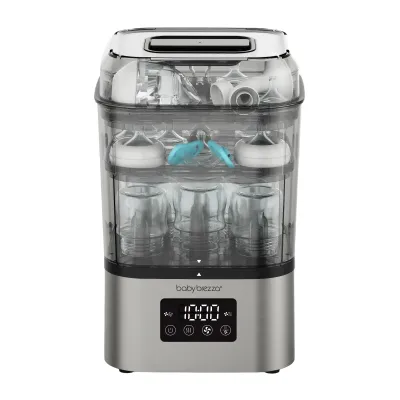
Prices are valid at publication and may change. Please refer to the product page for the latest price.
Sterilization Method The primary choice lies between steam and UV-C light. Steam sterilizers use high-temperature water vapor to eliminate pathogens, mimicking the traditional boiling method but with far greater control and less manual labor. UV-C sterilizers use specialized light bulbs to disrupt the DNA of microorganisms without using water or heat. Both methods are highly effective when used correctly, but they require different operational steps, cycle times, and care routines.
Drying Capability and Cycle Times Sterilizing is only half the battle; wet bottles left to air-dry on a counter can easily attract airborne contaminants. A built-in dryer uses filtered hot or warm air to dry bottles completely inside the machine, keeping them in a sterile environment until you are ready to use them. Cycle times vary significantly between models, with some steam cycles finishing in under 10 minutes, while full sterilization and drying cycles can range from 30 to 60 minutes depending on the load size and drying settings.
HEPA Filtration Because the drying process draws in air from the surrounding room, the quality of the filtration system is paramount. High-efficiency particulate air (HEPA) filters are integrated into many modern sterilizers to trap dust, pet dander, and airborne mold spores. This ensures that the air circulating over your freshly sanitized bottles is clean. When evaluating models, check how often the HEPA filter needs to be replaced and whether replacements are readily available.
Capacity and Footprint Consider how many bottles, nipples, collar rings, and pacifiers your family goes through in a single day. High-capacity units can hold up to six or eight bottles along with accessories, reducing the number of times you need to run the machine. However, larger capacity often means a larger physical footprint on your kitchen counter. You should measure your countertop depth and the clearance beneath your upper cabinets to ensure the unit fits comfortably without blocking workspace.
Bottle Compatibility Baby bottles come in a wide variety of shapes, sizes, and materials, including borosilicate glass, polypropylene (PP), polyphenylsulfone (PPSU), and silicone. While most standard bottles fit in modern sterilizers, some extra-wide neck bottles or tall 8-ounce options may require specific rack configurations. Always check the manufacturer’s specifications for both your bottles and the sterilizer to ensure a proper fit and to verify that your bottle materials can withstand the specific heat levels of your chosen machine.
Ease of Use and Interface When you are dealing with a crying baby in the middle of the night, you need an appliance that is straightforward to operate. Look for intuitive control panels with clear digital displays, simple one-touch automatic cycles, and bright indicator lights. Safety features such as an automatic shut-off function—which turns off the heating element once the cycle is complete—are essential for preventing overheating and providing peace of mind.
Comparing Baby Brezza Sterilizer and Dryer Options
To make an informed purchase, you must weigh the practical differences between steam-based and UV-based appliances. While both systems achieve the same goal of sanitizing your baby’s feeding gear, they do so through entirely different mechanisms that affect cycle speed, material compatibility, and daily maintenance.

The following table outlines the primary differences between these two technologies to help you determine which system fits best into your household routine.
| Dimension | Steam Sterilizers with Dryers | UV Sterilizers and Dryers |
|---|---|---|
| Sterilization Agent | High-temperature steam (requires water) | UV-C light rays (dry process) |
| Drying Mechanism | Heated fan-forced air with HEPA filter | Low-heat or circulating air with HEPA filter |
| Average Cycle Time | 30 to 60 minutes (total auto cycle) | 45 to 60 minutes (total auto cycle) |
| Material Compatibility | Best for heat-resistant glass and plastics | Safe for plastics, silicone, and electronics |
| Water Required | Yes (distilled or filtered water recommended) | No water required |
| Daily Maintenance | Regular descaling of the heating plate | Wiping reflective surfaces and bulb checks |
| Storage Mode | Keeps items sterile for up to 24 hours | Keeps items sterile with periodic UV cycles |
Steam Sterilizers with Built-in Dryers
Steam sterilizers remain the most popular choice for many families due to their straightforward operation and rapid sanitizing times. These units use a heating element in the base to boil a small amount of water, filling the sealed chamber with intense steam that quickly surrounds and sanitizes every surface of your bottles and accessories.
Once the sterilization phase is complete, the built-in drying system activates. This system typically utilizes a fan to blow hot, filtered air through the chamber, evaporating remaining water droplets from the complex curves of nipples and bottle vents. Because steam relies on heat, it is highly efficient, but it does require you to perform regular descaling to remove mineral buildup on the heating plate, especially when using local tap water in areas with high mineral content.
It is important to note that the high temperatures generated by steam units may not be suitable for all materials. Delicate breast pump components, certain soft silicone accessories, or items with integrated electronic parts can degrade, warp, or lose their structural integrity under extreme heat. Always consult the manufacturer instructions of your specific bottles and pump parts to confirm they are rated for steam sterilization before placing them in the machine.
UV Sterilizers and Dryers
UV sterilizers represent a modern, water-free alternative that uses ultraviolet-C light to eliminate bacteria and viruses. Because this process does not rely on boiling water, it operates at much lower temperatures, making it exceptionally gentle on plastic and silicone components, which can prolong the lifespan of your baby bottles.
The drying process in a UV sterilizer typically uses low-heat convection or circulating air to gently dry items without exposing them to high thermal stress. This waterless operation completely eliminates the need for descaling, saving you time on routine maintenance. Additionally, because there is no moisture or high heat involved, you can safely sanitize non-feeding items such as plastic toys, teethers, pacifiers, and even certain small household electronics like remote controls, keys, or mobile phones.
However, UV light sterilization has distinct physical limitations. UV-C rays can only sanitize surfaces that they directly strike; any area in a shadow or blocked by another object will not be fully sterilized. This means you must carefully arrange your items on the internal racks, ensuring they do not overlap or touch. The capacity of UV units can also be somewhat limited by the necessity of maintaining open lines of sight between the bulbs and the bottles, requiring a more deliberate loading process.
Matching the Device to Your Household and Feeding Routine
Selecting the ideal Baby Brezza appliance requires looking beyond the technical specifications and evaluating how the machine will integrate into your daily life. Your feeding method, kitchen layout, and sleep schedule all play a role in determining which model will serve you best over the coming months.
High-Volume Feeding and Exclusive Pumping If you are exclusively pumping or formula-feeding multiple times a day, you will generate a large volume of bottles and parts. In this scenario, capacity and speed are your top priorities. A high-capacity steam sterilizer and dryer is usually the most efficient choice, as it allows you to load six to eight bottles along with multiple breast pump flanges and valves in a single run. The rapid steam phase ensures you can cycle through multiple loads quickly to keep up with a demanding feeding schedule.
Space-Constrained Kitchens and Multi-Purpose Needs For families living in compact apartments or homes with limited counter space, a multi-functional UV sterilizer can be highly advantageous. Because UV sterilizers do not generate steam or moisture, they do not need to be placed near a sink or away from overhead wooden cabinets that could be damaged by escaping humidity. Furthermore, many UV models feature a “storage” mode that periodically runs the UV light to keep items sterile inside the machine for days, allowing the appliance to double as a clean, dust-free cabinet for your baby gear.
Nighttime Routines and Noise Levels If your kitchen is located close to your sleeping quarters, or if you frequently run sterilization cycles in the middle of the night, look for a unit known for quiet operation. Many modern Baby Brezza models are designed to operate at low decibel levels, allowing you to initiate a one-touch automatic cycle before going to bed without worrying about waking a sleeping infant. The automatic shut-off feature ensures that the machine safely powers down once the drying cycle is complete, letting you rest undisturbed.
Local Considerations in the Philippines When purchasing a Baby Brezza sterilizer in the Philippines, it is vital to source your appliance from authorized local retailers or the brand’s official online store. This ensures that you receive a unit configured for the local voltage standard of 220V to 240V at 60Hz, preventing electrical damage or fire hazards associated with running 110V imported models without a transformer. Purchasing locally also guarantees access to official customer support, valid local warranties, and genuine replacement parts or filters. Expect prices to fall into broad bands, with entry-level steam models generally ranging from ₱5,000 to ₱8,000, while advanced UV-C sterilizers typically sit in the premium tier of ₱12,000 to ₱18,000.
Essential Safety and Maintenance Guidelines
To keep your sterilizer operating efficiently and to protect your baby’s health, you must establish a consistent maintenance routine. Neglecting basic care can lead to mineral buildup, reduced drying efficiency, or premature wear of the appliance’s heating and electrical components.
Descaling Steam Models Over time, the water boiled in steam sterilizers leaves behind mineral deposits, commonly known as limescale, on the metal heating plate. To remove this, you should descale the unit every one to two weeks. Pour a mixture of equal parts white vinegar and distilled water (or a manufacturer-approved citric acid solution) onto the heating plate, let it sit for approximately 30 minutes, and then wipe the surface clean with a soft cloth. Always rinse the plate thoroughly with clean water afterward and dry it completely before running another cycle.
Cleaning UV Bulbs and Reflective Interiors For UV sterilizers, maintaining the cleanliness of the inner reflective walls and the UV-C bulbs is critical. Dust, fingerprints, or water spots on these surfaces can block or scatter the UV light, reducing its sanitizing effectiveness. Before cleaning, always unplug the device from the wall outlet. Gently wipe the interior walls and the bulbs with a dry, lint-free microfiber cloth. Never use abrasive cleaners, harsh chemicals, or wet sponges directly on the electrical components or light bulbs.
Optimizing Water Quality If you are using a steam-based sterilizer, the type of water you pour into the reservoir directly affects how often you will need to descale. Tap water in many regions contains high levels of dissolved minerals like calcium and magnesium. To minimize mineral buildup and prevent white residue from forming on your baby’s bottles, always use distilled or high-quality filtered water.
Safety Boundaries and Warning Signs Always prioritize safety when operating any electrical appliance that combines water and heating elements. Never submerge the base of a steam sterilizer in water, and ensure your hands are completely dry before touching the plug or control panel. If you notice a damaged power cord, an unusual burning odor, or if the unit fails to heat properly, stop using the appliance immediately. Consult your user manual for troubleshooting steps or contact the authorized local customer support center for professional repairs rather than attempting to fix electrical components yourself.
Frequently Asked Questions (FAQ)
Can I put breast pump parts in a Baby Brezza sterilizer?
Yes, you can sterilize most standard breast pump parts in a Baby Brezza sterilizer, but you must first verify the material guidelines provided by your breast pump manufacturer. Hard plastic flanges, silicone valves, and connectors are typically safe for steam or UV sterilization. However, delicate components, tubing, or parts containing metal or electronic elements must never be placed inside the sterilizer. If the instructions from your breast pump manufacturer conflict with those of the sterilizer, always defer to the pump manufacturer’s care guidelines to avoid damaging your equipment.
How often should I sterilize my baby bottles?
Health experts generally recommend sterilizing baby bottles and feeding accessories at least once a day for infants under three months of age, premature babies, or those with weakened immune systems. For older, healthy babies, daily sterilization may not be strictly necessary if you have access to safe, clean drinking water and wash bottles thoroughly with hot, soapy water after every use. However, in tropical environments where high humidity can accelerate bacterial growth on damp surfaces, running a daily sterilization and drying cycle remains an excellent practice for maintaining optimal hygiene. Consult your pediatrician for personalized guidance based on your baby’s health.
Why is my Baby Brezza sterilizer leaving white residue on bottles?
A white, chalky residue on your bottles or the sterilizer’s heating plate is caused by mineral buildup, also known as limescale. This occurs when tap water, which contains minerals like calcium and magnesium, is heated and evaporated during the steam cycle. To resolve this issue, descale the heating plate using a mixture of white vinegar and water as outlined in your user manual, and thoroughly rinse the bottles if they have residue on them. To prevent future buildup, switch from tap water to distilled or highly filtered water for all subsequent sterilization cycles.
Community discussion
Share your experience or ask a question. Comments are reviewed before publication.