
Quick Answer: Which Walker is Safer and Better for Development?
When your baby starts showing signs of wanting to move, choosing the right walker for your baby is one of the most significant decisions you will make regarding their early mobility gear. If you are deciding between a traditional sit-in walker and a modern push-behind walker, pediatric experts generally favor push-behind models. Push walkers support natural motor development, encourage active balance, and provide caregivers with significantly better control over environmental hazards.
In contrast, traditional sit-in models carry a much higher risk of accidental falls and grant babies rapid access to household hazards before they possess the cognitive awareness to avoid them. Furthermore, the suspended mechanical design of a sit-in model does not replicate the natural biomechanics required for independent walking. Before purchasing any mobility device, parents should verify current pediatric guidelines, check for active product recalls, and review manufacturer safety certifications to ensure the highest level of protection.
Sit-In vs. Push Walkers: Core Design and Functionality
To make an informed choice, it is essential to understand how these two devices differ in their structural design and how they interact with your baby’s physical frame.
Products mentioned in this guide
![[Easy To Walke] Bobbi Baby Walker walker for baby boy baby walker for girl SuitableFor 6-18 Months Infant Foldable walker for baby with Wheel Toddler Walk Learning Anti Rollove walker baby girl walker for baby With Music and Handle](https://img.lazcdn.com/g/p/e556e95d1e84b3034168d74ed603b3ce.jpg_400x400q80.jpg_.webp)
Prices are valid at publication and may change. Please refer to the product page for the latest price.

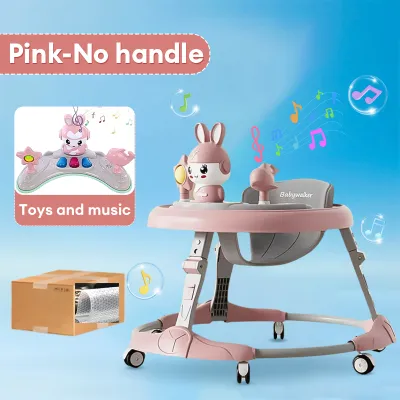
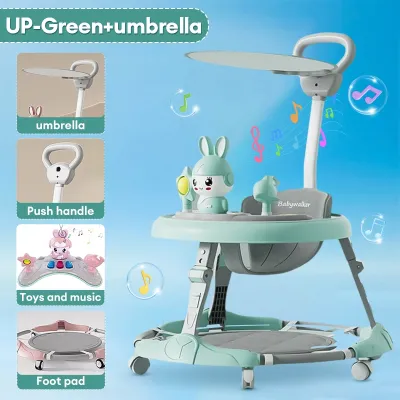
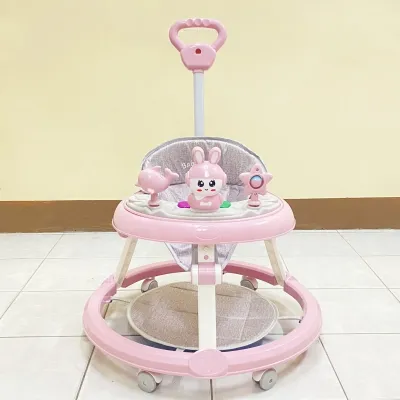
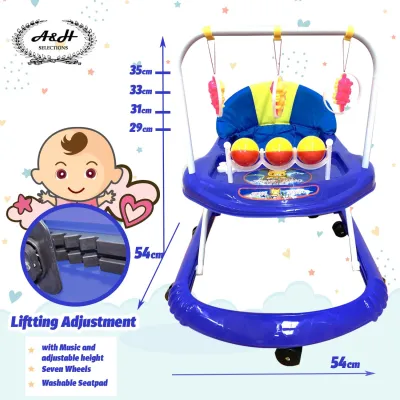
A traditional sit-in walker features a fabric seat suspended inside a rigid plastic frame, which is supported by a wide, wheeled base. The baby sits inside this harness with their feet dangling to touch the floor, completely surrounded by a protective tray that often includes toys or activities. Because the seat supports the baby’s body weight, mobility is generated primarily by the child pushing off the floor with their toes, sliding the wheeled frame across the room. These wheels are typically multi-directional caster wheels, allowing the baby to glide in any direction with minimal effort, even before their leg muscles are strong enough to support their upright weight.
A push-behind walker, on the other hand, is an active, open-frame device designed for babies who are already learning to stand. It consists of a weighted wheeled frame, often styled as a toy cart, lawnmower, or activity center, with a sturdy handle positioned at the baby’s chest or waist height. The baby stands completely on their own feet behind the device, grips the handle, and pushes it forward to take active steps. Unlike the multi-directional wheels of a sit-in model, push walkers usually have inline wheels that move primarily forward and backward, which helps guide the baby in a straight, predictable path as they practice stepping.
The fundamental difference between these two designs lies in weight-bearing and the center of gravity. In a sit-in model, the baby’s weight is supported by the seat, which lowers their active engagement and shifts their center of gravity backward. In a push model, the baby must bear their full body weight, balance their own torso, and actively control both the speed and direction of the device using their core and leg muscles.
Safety Comparison: Evaluating Risks and Hazard Prevention
Evaluating the safety profiles of these devices requires looking closely at how babies interact with their environment while using them.
Traditional sit-in models present unique safety challenges because of the speed and height advantage they give to pre-walking infants. A baby in a wheeled sit-in device can move at surprisingly high speeds—sometimes reaching up to one meter per second—giving caregivers very little time to react. This rapid mobility allows them to reach previously inaccessible hazards, such as hot liquids on low tables, electrical cords, heavy objects on countertops, or toxic household cleaners. Most critically, sit-in models are associated with serious fall risks, particularly down stairs or over thresholds, where the momentum of the wheeled base can cause the entire unit to tip over.
In many Philippine homes, architectural layouts often feature open-plan living spaces that transition directly into wet areas, dirty kitchens, or outdoor patios. These transitions frequently involve small steps, raised thresholds, or sudden level changes that pose a significant hazard for a baby in a wheeled sit-in device. If a sit-in model strikes a threshold at high speed, the momentum can easily cause the frame to tip over forward or sideways, leading to head or neck injuries. Similarly, homes with split-level designs or un-gated entryways to stairs require absolute vigilance, as a wheeled device can travel several feet in the blink of an eye, bypassing safety barriers if they are not securely locked.
While push-behind models are generally considered safer, they are not entirely without risks. The primary concern with a push walker is that it can tip backward if a baby attempts to pull themselves up using the handle from a sitting position instead of standing up independently first. Additionally, on smooth, polished surfaces—such as the ceramic tiles or polished concrete floors common in many Philippine homes—a lightweight push model can roll forward too quickly. If the wheels lack sufficient traction or resistance, the baby may lose their balance and fall forward onto the frame or floor. High humidity levels in tropical climates can also make tiled floors slightly slick, increasing the risk of sliding if the wheels do not have adequate rubber grips.
To mitigate these risks, caregivers must carefully verify specific safety features before introducing any device. Look for push models that feature adjustable wheel friction or locking mechanisms, which allow you to slow down the rolling speed on slick floors. For sit-in models, check for rubber friction strips on the underside of the base designed to grip the floor and stop the device if a wheel drops over an edge. Ensure any product you choose complies with recognized safety standards, such as those set by the American Society for Testing and Materials (ASTM) or European safety equivalents.
No matter how many safety features a manufacturer includes, active, close-proximity adult supervision remains the absolute rule. A baby using any mobility device should never be left alone, even for a brief moment, and safety gates must be securely installed at all stairways and doorways to prevent access to high-risk areas.
Impact on Motor Skills and Walking Development
The physical mechanics of how a baby moves can have lasting effects on their musculoskeletal development and walking timeline.
When a baby is placed in a sit-in model, their body alignment is altered significantly compared to natural standing. Because they are suspended in a fabric harness, they frequently rely on their toes to push themselves around, which can lead to tight calf muscles and a persistent habit of toe-walking. This position bypasses the essential strengthening of the hips, thighs, and ankles that occurs when a baby bears their full weight. If you are concerned about how this posture might affect your child’s physical development, it is highly recommended to consult a pediatrician or pediatric physical therapist to discuss your baby’s specific motor milestones.
Conversely, push-behind models support natural, upright biomechanics. When pushing a sturdy cart, the baby stands flat-footed, which encourages proper heel-to-toe walking alignment. This active movement requires the child to engage their core, hips, and thighs to maintain balance and propel themselves forward. It serves as a natural bridge between “cruising” along living room furniture and taking independent, unsupported steps, allowing the baby to build muscular strength at their own developmental pace.
Furthermore, learning to walk is not just about muscle strength; it is also a complex neurological process involving the vestibular system, which regulates balance and spatial orientation. When a baby stands and takes steps independently or with a push-behind cart, they experience minor slips, wobbles, and falls. These small, safe losses of balance are actually crucial learning moments for the brain, teaching the nervous system how to make rapid postural adjustments to stay upright. A sit-in model deprives the baby of these essential feedback loops because the fabric harness constantly catches them, preventing them from experiencing the natural consequences of gravity and balance correction.
Cognitive and spatial awareness also develop differently depending on the device. In a sit-in model, the large plastic tray physically blocks the baby’s view of their lower body, preventing them from seeing their feet as they move. This obstruction disrupts the sensory-motor feedback loop that is vital for learning how to navigate obstacles. A push model keeps the baby’s view of their feet and the ground entirely clear, helping them build spatial reasoning, depth perception, and a better understanding of physical boundaries.
Despite the appeal of these devices, pediatric experts emphasize that unrestricted floor time is the single most important factor for gross motor development. Before a baby is ready to walk, they must develop core stability, coordination, and bilateral integration through crawling and rolling. Crawling, in particular, builds cross-lateral coordination—the coordinated movement of the opposite arm and leg—which is essential for healthy brain development and physical balance. Placing a baby in a sit-in walker too early can limit their opportunities to crawl, potentially delaying the natural progression of these fundamental motor skills.
Side-by-Side Feature and Convenience Comparison
For daily household use, practical features like storage, cleaning, and adaptability are major considerations for busy parents.
The following table outlines the key differences in design, developmental suitability, and safety considerations between the two options:
| Comparison Dimension | Sit-In Baby Walker | Push-Behind Baby Walker |
|---|---|---|
| Recommended Stage | Able to sit upright unsupported; feet must touch floor | Actively pulling up to stand and cruising along furniture |
| Biomechanical Focus | Toe-pushing; passive leg movement without full weight-bearing | Active weight-bearing; natural heel-to-toe walking mechanics |
| Primary Safety Risk | Rapid mobility; high risk of stair falls and reaching hazards | Backward tipping if pulled incorrectly; sliding on slick floors |
| Floor Space Required | Large footprint; requires wide, open, single-level spaces | Moderate footprint; easier to navigate around furniture |
| Multi-functionality | Often limited to stationary play trays or simple bouncer modes | Frequently converts to activity tables, toy carts, or puzzles |
Beyond physical development, daily maintenance is a key factor to keep in mind. In warm, humid environments like the Philippines, fabric seats on sit-in models can quickly trap sweat and moisture, requiring frequent removal and machine washing to prevent mold and skin irritation. Push-behind models, typically constructed from smooth plastic or finished wood, are much easier to clean, requiring only a quick wipe down of the handles and frame with a damp cloth. Additionally, push models are often highly compact or fold flat, making them easier to store in smaller living spaces compared to the bulky, rigid frames of traditional sit-in units.
Decision Framework: Choosing the Right Walker for Your Baby
Making the final choice depends on evaluating your baby’s current developmental milestones and the physical layout of your home.
Choose a Push Walker if:
- Your baby is already showing a strong desire to stand, is actively pulling themselves up on furniture, or is cruising sideways along the couch.
- You want to actively support natural walking posture, balance, and core strength.
- Your home has smooth tiled or wooden floors where you can adjust wheel resistance to help your baby practice steady, controlled steps.
- You prefer a versatile toy that can grow with your child, often transforming into an activity table or a toy cart for toddlers.
Avoid Sit-In Walkers if:
- Your primary goal is to help your baby achieve independent walking milestones quickly, as studies show these devices do not accelerate natural development.
- Your home has steps, split-level flooring, un-gated stairs, or tight doorways where a wheeled frame could easily tip or trap fingers.
- You have limited storage space and prefer gear that can be easily tucked away when not in use.
Verify First if:
- Your baby has any pre-existing physical developmental delays, low muscle tone, or orthopedic conditions. In these cases, always consult a pediatrician or pediatric physical therapist before introducing any type of mobility aid.
- You are buying a new or second-hand model. Always run a quick check on the manufacturer's official website to ensure the specific model has not been subject to safety recalls, and carefully inspect the frame for cracks, loose screws, or worn-out wheel grips.
Frequently Asked Questions (FAQ)
At what age can a baby start using a push walker?
Readiness is determined by physical milestones rather than a precise age. Most babies are ready to try a push model when they can pull themselves up to stand independently and cruise along furniture, which typically occurs between 9 and 12 months. Always check the manufacturer’s documentation for specific weight and height limits before use.
Do baby walkers help babies learn to walk faster?
No, clinical evidence and pediatric consensus show that walkers do not help babies walk sooner. In fact, overusing sit-in models can sometimes delay independent walking by encouraging improper muscle use. The most effective way to help your baby walk is through plenty of supervised, unstructured floor play.
Are sit-in baby walkers banned or restricted in some regions?
Yes, several countries, including Canada, have completely banned the sale, importation, and advertisement of sit-in baby walkers due to historical injury data. While they are still available on online marketplaces in the Philippines, local pediatric associations strongly discourage their use, advising parents to opt for stationary activity centers or push-behind models instead.
Community discussion
Share your experience or ask a question. Comments are reviewed before publication.