
Quick Answer: Jumperoo or Baby Bouncer?
Choosing between a stationary jumper and a baby bouncer depends on your baby’s developmental stage, your home’s layout, and how you plan to use the gear. A stationary jumper, often referred to as a Jumperoo style, features a suspended seat within a freestanding frame and an integrated activity tray designed for active, upright play. In contrast, a baby bouncer is a low-slung, angled seat on a flexible wireframe that gently bounces in response to your baby’s natural kicks and shifts.
If you have dedicated floor space and a baby who can hold their head up confidently, a stationary jumper offers an engaging environment for active play. If you need a highly portable, space-saving option that can soothe a younger infant while you manage household tasks, a baby bouncer is generally the more practical choice. Balancing these factors helps ensure you select the gear that best supports your daily routine and your baby’s current physical milestones.
Understanding the Basics: Stationary Jumpers vs. Bouncers
To make an informed decision, it is essential to understand how these two types of baby gear operate. A stationary jumper relies on a robust, freestanding frame—often made of metal or heavy-duty plastic—from which a fabric seat is suspended by covered elastic cords or springs. This design allows your baby to push off the floor with their feet, creating a fun, vertical bouncing motion. Most stationary jumpers feature a 360-degree rotating seat surrounded by an interactive toy tray filled with lights, music, and textures to keep your baby entertained in an upright position.
Products mentioned in this guide


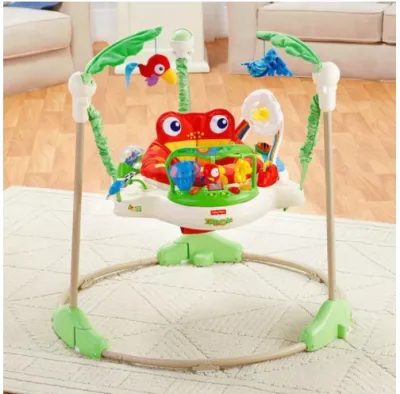


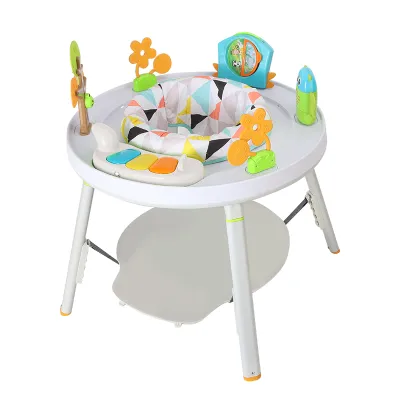
Prices are valid at publication and may change. Please refer to the product page for the latest price.

A baby bouncer operates on a much simpler, non-motorized mechanical principle. It consists of a fabric seat stretched over a lightweight, flexible metal or plastic frame. Rather than relying on springs, the bouncer responds directly to your baby’s own movements; when they wiggle their arms or kick their legs, the frame flexes to create a gentle, rhythmic bouncing or rocking motion. Some models include a basic, removable toy bar overhead to encourage reaching, but the primary focus is on comfort, relaxation, and gentle stimulation.
Because these items serve different purposes, they also align with different developmental milestones. Many baby bouncers are suitable from birth, provided they offer adequate head and neck support or include specialized infant inserts. However, you must stop using a bouncer as soon as your baby attempts to sit up unassisted or reaches the manufacturer’s specified weight limit. Stationary jumpers require a higher level of physical development; your baby must have full, consistent head and neck control before using one. You should discontinue jumper use once your baby begins to walk, stand flat-footed comfortably on the floor even at the highest adjustment setting, or attempts to climb out of the seat.
Comparing Space, Portability, and Development
When deciding which gear to bring into your home, evaluating how each item fits into your physical living environment and supports your baby’s growth is crucial. Comparing their physical footprint, ease of movement, and developmental engagement will help you identify the best match for your family’s lifestyle.
Space and Storage Requirements
Stationary jumpers require a significant amount of dedicated floor space. The wide, circular or triangular base of a jumper frame is designed to prevent tipping during vigorous jumping, meaning it can easily dominate a small living room or bedroom. While some models offer a folding mechanism for storage, they remain relatively bulky and are difficult to tuck away quickly when guests arrive or when you need to clear the floor.
Baby bouncers are highly compact and low-profile. They occupy a minimal footprint on the floor, making them ideal for smaller apartments or shared living spaces. When not in use, many modern bouncers fold completely flat, allowing you to slide them under a sofa, place them behind a door, or store them in a closet without disrupting your home’s layout.
Portability and Travel
If you frequently move from room to room to keep an eye on your baby while attending to chores, portability is a major consideration. Baby bouncers are exceptionally lightweight, often weighing under three kilograms. This makes them easy to pick up with one hand and carry from the kitchen to the laundry area. Their flat-folding design also makes them highly travel-friendly, fitting easily into a car trunk for trips to visit relatives or for weekend getaways.
Stationary jumpers are not designed for frequent travel or easy relocation. They are heavy, cumbersome to carry through doorways, and typically require partial disassembly to move between rooms. A jumper is best treated as a semi-permanent fixture in a designated play area rather than a portable companion for on-the-go parenting.
Developmental Benefits and Play Value
The upright position of a stationary jumper encourages your baby to explore vertical movement, helping them practice balance and coordination as they push off the ground. The surrounding toy tray provides rich sensory stimulation, promoting hand-eye coordination and cause-and-effect learning as your baby presses buttons, spins rollers, and reaches for hanging toys. However, because of the physical demands of upright bouncing, sessions should be kept short to prevent overexertion.
Baby bouncers offer a calmer, more relaxed environment. The gentle, self-induced rocking motion helps babies learn to self-soothe and understand how their body movements affect their immediate surroundings. While bouncers do not offer the high-energy play of a jumper, their simpler toy bars encourage early reaching and grasping without overwhelming a younger infant’s developing nervous system. Always verify the specific weight, height, and developmental limits printed on the product packaging or manual to ensure your baby is using the gear safely.
How to Decide: Choosing the Right Gear for Your Baby
To help you finalize your choice, consider how your daily routine, home environment, and baby’s temperament align with the following scenarios.
Choose a Stationary Jumper if…
- You have ample, dedicated floor space in your living area where the gear can remain assembled.
- Your baby is at least four to six months old, exhibits strong, consistent head and neck control, and loves being held in an upright standing position.
- You want a secure, contained activity center that provides high-energy entertainment and sensory play for short periods while you supervise nearby.
- You are looking for gear that encourages active leg movement and physical play.
Choose a Baby Bouncer if…
- You live in a compact home, apartment, or need gear that can be easily folded and stored out of sight.
- You need a lightweight, highly portable seat that you can easily carry from room to room to keep your baby close by during daily tasks.
- Your baby is a newborn or young infant who benefits from a reclined, soothing environment to rest and watch the family.
- You want a simple, low-tech option that does not require batteries, electrical outlets, or complex assembly.
Verify first if… Before making any purchase, always check the manufacturer’s product manual to verify the maximum weight and height limits. Inspect the stability of the frame and look for clear safety certifications on the packaging. If you are buying secondhand, ensure all original straps, buckles, and toy attachments are intact, fully functional, and free from wear or damage.
Safety Checks and Usage Limits for Activity Gear
Regardless of which gear you choose, safety must always be your top priority. Always read and follow the manufacturer’s instructions for assembly, adjustment, and usage limits.
- Monitor Milestones and Limits: Check your baby's weight and height against the product's limits before every use. Discontinue using a bouncer immediately if your baby attempts to sit up on their own. Stop using a jumper as soon as your baby can walk independently or if they can stand flat-footed in the seat even at its highest setting.
- Maintain Constant Supervision: Never leave your baby unattended in any activity gear. These items are designed for supervised play and relaxation, not for unsupervised sleep or extended containment.
- Keep Gear on the Floor: Always place both stationary jumpers and baby bouncers on flat, level, and stable floor surfaces. Never place a baby bouncer on elevated surfaces such as tables, countertops, sofas, or beds, as the baby's movements can cause the seat to slide or tip over, risking serious injury.
- Inspect Regularly: Periodically check the frame for structural integrity, ensure all seat straps and buckles secure tightly, and verify that toy attachments are firmly locked in place. If you notice any frayed fabric, cracked plastic, or loose springs, stop using the item immediately and contact the manufacturer.
Frequently Asked Questions (FAQ)
Can a baby use both a jumperoo and a bouncer?
Yes, a baby can use both types of gear, as they serve complementary roles at different times of the day. A baby bouncer is excellent for quiet, relaxed moments when your baby wants to sit semi-reclined and watch you fold laundry or prepare a meal. A stationary jumper is ideal for active, high-energy play sessions when your baby is wide awake and eager to bounce.
If you choose to use both, it is vital to monitor the total cumulative time your baby spends in restrictive seating devices each day. Pediatric experts generally recommend prioritizing floor time, such as tummy time and free play on a play mat, to support natural motor development and muscle strength. Limit sessions in jumpers or bouncers to short intervals, typically no more than 15 to 20 minutes at a time.
Are doorway jumpers safer than stationary jumpers?
Freestanding stationary jumpers are generally considered a more stable option than doorway jumpers. A stationary jumper relies on its own wide, engineered frame designed to distribute weight evenly and absorb the forces of active bouncing. This self-contained design eliminates the risk of the gear shifting or tipping due to structural failures in your home.
Doorway jumpers, which clamp onto overhead door frames, introduce several unique risks. They rely entirely on the strength and trim profile of your home’s door frames, which can vary significantly. There is also a risk of the baby swinging sideways and colliding with the door frame or wall, or the clamp slipping during vigorous play. If you choose to use a doorway model, you must strictly follow the manufacturer’s installation instructions, verify your door frame’s compatibility, and maintain constant, active supervision at all times.
Community discussion
Share your experience or ask a question. Comments are reviewed before publication.