
To properly wear and adjust your Aprica baby carrier, you must secure the waist belt snugly on your hips or natural waist, position your baby with their hips in an ergonomic “M-shape” (knees higher than or level with their bottom), and tighten the shoulder straps to keep them close to your chest.
Ensuring safe positioning requires verifying that your baby’s airway remains completely clear, their chin is off their chest, and their face is visible at all times. By mastering these key adjustments, you can distribute your baby’s weight evenly across your body while keeping them secure and comfortable during daily activities.
Before You Begin: Safety Boundaries and Preparation
Every baby carrier model has unique weight and developmental limits that are non-negotiable for safety. Before using your Aprica baby carrier, locate the safety label stitched onto the carrier or consult the official instruction manual.
Products mentioned in this guide
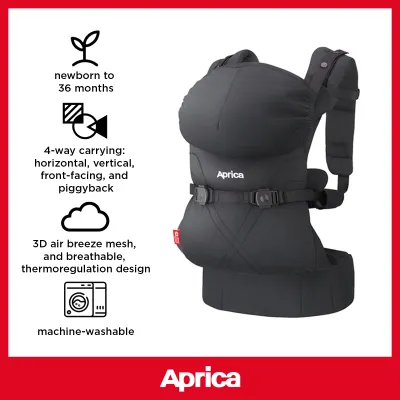
Prices are valid at publication and may change. Please refer to the product page for the latest price.
Verify that your baby’s current weight, age, and developmental stage align precisely with the manufacturer’s specified ranges. Some models are designed for newborns with specific inserts, while others are strictly intended for older infants who have achieved independent head control. Never assume a universal fit, as using a carrier outside its intended specifications can compromise your baby’s structural support and airway safety.
Perform a thorough structural inspection of the carrier before every single use. Lay the carrier flat on a clean surface and inspect all plastic buckles, adjustment straps, fabric panels, and seams. Look closely for any signs of fraying, loose stitching, or cracked buckles.
Even minor wear can fail under the tension of a baby’s weight, leading to accidental falls. If you find any damage or if a buckle does not click securely into place, stop using the carrier immediately and contact the manufacturer or a certified repair service.
Consider the tropical and humid climate of the Philippines when preparing your baby for a carry. High ambient temperatures and humidity levels mean that the carrier itself acts as an insulating extra layer of clothing, wrapping your baby in dense fabric.
To prevent heat stress, dress your baby in lightweight, breathable cotton clothing, such as a simple onesie. Avoid thick fabrics, heavy layers, or footed sleepers that can restrict leg movement or trap excess body heat.
Monitor your baby’s comfort and hydration closely during warm days. When walking outdoors in the heat, seek shade and take regular breaks to let both you and your baby cool down.
Keep in mind that direct sun exposure can quickly heat up the carrier’s dark fabrics or metal and plastic components. Touch the buckles and straps to ensure they are not too hot before placing your baby inside.
Step-by-Step: Putting on the Carrier and Positioning Your Baby
Putting on your baby carrier correctly is essential for maintaining your own posture and ensuring your baby is securely supported from the moment you lift them. Following a disciplined sequence ensures that the carrier is fully stabilized on your body before you introduce the weight of your child.

Securing the Waist and Shoulder Straps
Position and secure the waist belt first. Wrap the padded waist belt around your torso, placing it either on your hips or at your natural waist, depending on the specific design of your Aprica model. For younger or smaller babies, wearing the belt higher on your waist helps keep the baby close enough to kiss.
Thread the male end of the buckle through the safety elastic loop if your model features one, then insert it into the female buckle until you hear a distinct click. Pull the webbing tail to tighten the belt until it fits snugly and firmly against your body.
The waist belt must be tight enough that it does not slide down or tilt forward under the baby’s weight. A loose belt transfers the load directly to your shoulders and lower back, causing significant muscle strain.
Prepare the shoulder straps for use. Before lifting your baby, ensure that the shoulder straps are fully untwisted and hanging freely down your sides. If you are putting the carrier on alone, it is helpful to pre-adjust the chest or back strap to a height you can easily reach behind your head.
Ensure that all adjustment webbing is lengthened slightly so you have enough slack to slide your arms through comfortably once the baby is in position, but not so loose that the carrier loses its structure.
Connect and adjust the chest or back clip. Once your arms are through the shoulder straps, bring your hands behind your upper back to locate the chest clip. Align the two halves and snap them together securely.
Adjust the height of this clip so it sits across the middle of your shoulder blades, which prevents the shoulder straps from slipping outward off your shoulders. The chest clip should be snug enough to keep the shoulder straps parallel and flat against your chest, but not so tight that it constricts your breathing or pulls the straps uncomfortably close to your neck.
Placing Your Baby in the Carrier
Lift your baby with careful physical support. Hold your baby securely against your chest, using one hand to support their head and neck and the other to support their bottom.
Gently guide one leg at a time through the designated leg openings of the carrier fabric. Ensure that your baby’s thighs are supported by the fabric and that their legs are free to bend naturally at the knees. Keep a firm, continuous hold on your baby’s body with at least one hand throughout this entire process; do not rely on the unadjusted carrier to support them yet.
Draw the main fabric panel up over your baby’s back. While maintaining a secure hold on your baby with one hand, use your other hand to pull the fabric panel upward over your baby’s back.
The fabric should lie smooth and flat against their spine, extending to an appropriate height based on their development. For newborns and young infants who cannot support their own heads, the panel must reach the nape of the neck to provide essential structural support. For older babies with strong head and neck control, the panel can sit lower, around the armpit level, allowing them to look around safely.
Verify that the panel does not obstruct the baby’s airway. Under no circumstances should the fabric panel or any head support accessory cover your baby’s mouth or nose.
The fabric must stop below the earlobe level, and any sleep hood or sunshade should be left open or loose enough to allow continuous, unrestricted airflow. If the fabric panel is too high for your baby’s torso, stop and adjust the seat depth or consult your manual to see if a newborn cushion or alternative adjustment is required to raise their position within the carrier.
Maintain constant visual contact with your baby’s face. Throughout the entire positioning process, keep your baby’s face fully visible to you. Their head should be slightly turned to one side so that their nose and mouth are completely clear of your clothing and the carrier fabric.
Never allow your baby’s face to press flat against your chest. This can lead to positional asphyxiation, which can occur silently without any obvious signs of struggle.
Fine-Tuning the Fit for Ergonomic Support
Tighten the shoulder straps to eliminate slack. Locate the adjustment buckles under your arms or on the front of the shoulder straps, depending on your Aprica model’s configuration.
Pull the webbing straps backward or forward in a smooth, even motion to tighten them. As you tighten, use your other hand to gently lift your baby’s weight from underneath; this relieves tension on the buckles and allows you to achieve a snugger, more accurate fit.
The straps should be tight enough to hold your baby’s torso flush against your chest, preventing them from slumping or shifting when you move, but not so tight that it presses them uncomfortably hard against you.
Establish the ergonomic “M-shape” hip position. Look down at your baby’s legs to verify that they form a wide, healthy “M” posture, which is critical for proper hip joint development.
In this position, your baby’s knees must be bent and positioned slightly higher than, or at least level with, their bottom. Their thighs should spread wide around your torso, with the weight of their lower body distributed evenly across their thighs and buttocks rather than hanging straight down. This spread-squat position reduces the risk of hip dysplasia by keeping the femoral head securely centered in the hip socket.
Adjust the seat width to support the legs from knee to knee. Many Aprica models feature adjustable seat bases using velcro tabs, snaps, or sliding mechanisms to accommodate growing babies.
Inspect the seat width to ensure the fabric extends fully from one knee crease to the other, supporting the entire length of the thigh. The fabric must not bunch up in the crotch area, which causes the legs to dangle vertically, nor should it extend past the knee creases, which would force the baby’s lower legs straight and restrict their ability to bend their knees freely. Adjust the seat width settings according to your baby’s size as specified in your product’s care and use instructions.
Fine-tune the parent’s chest strap for optimal comfort. The chest strap connects the two shoulder straps across your back (or across your chest if you are carrying the baby on your back).
Slide the strap adjusters up or down along the shoulder straps until the connector sits comfortably in the upper-middle zone of your shoulder blades. Tighten or loosen the chest strap webbing so that the shoulder straps sit securely on the center of your shoulders. This prevents the straps from pinching your neck or sliding outward off your shoulders, ensuring your arms retain their full range of motion without restriction.
The Final Safety Check: Verifying Correct Positioning
Perform the mandatory TICKS safety check immediately after securing your baby in the carrier. This globally recognized standard helps ensure your baby remains safe, comfortable, and anatomically supported throughout your babywearing session. Take a moment to walk through each element of the checklist methodically before you begin walking or performing other tasks.
Tight and secure fit. The carrier fabric must be sufficiently snug to hold your baby close to your body. Test this by leaning forward slightly; your baby should not slump away from your chest or shift out of position. A loose carrier allows the baby to curl downward, which can collapse their airway and cause significant physical discomfort or strain on your back.
In view at all times. You must be able to see your baby’s face, eyes, and airway clearly simply by looking down. The fabric of the carrier, your clothing, or any accessories must not block your view. If you have to pull back fabric or shift your baby’s head to see their nose and mouth, the positioning is incorrect and must be adjusted immediately.
Close enough to kiss. Your baby’s head should be positioned high up on your chest, close to your chin. When you tip your head forward, you should be able to easily kiss the top of your baby’s head or forehead without straining your neck. If your baby is riding too low, loosen the shoulder straps slightly, lift your baby higher onto your chest, and retighten the waist belt higher up on your torso before securing the shoulder straps again.
Keep chin off the chest. Carefully observe the space under your baby’s chin. There must be a gap of at least one finger’s width between their chin and their chest to keep their airway completely open. If their head is forced forward so that their chin presses against their chest, it can severely restrict their breathing. This is a critical risk, especially for newborns who lack the neck strength to lift their heads.
Supported back in a natural curve. In a front carry, your baby’s back should be supported in its natural, slightly rounded “C-curve.” The carrier panel should be tight enough to support this natural posture without forcing their spine into an unnaturally straight line, but loose enough to prevent them from slumping into a chin-to-chest position.
Identify immediate “stop and adjust” conditions. If at any point during use you notice your baby’s face is pressed flat against your chest, if the carrier fabric or your clothing covers their nose or mouth, or if your baby seems unusually restless, fussy, or hot, stop what you are doing immediately.
Find a safe place to sit down, remove your baby from the carrier, and address the issue. Never attempt to adjust a highly loose or unstable carrier while walking or distracted; always prioritize a controlled, stable environment to secure your baby’s safety.
Frequently Asked Questions (FAQ)
Does my specific Aprica model require a newborn insert?
Whether your Aprica carrier requires a newborn insert depends strictly on the specific model and its manufacturing year. Some models feature built-in, adjustable seat panels and integrated neck supports designed to safely hold a newborn without extra accessories, while other models strictly require a dedicated infant insert to provide the necessary head, neck, and hip support. Always verify your carrier’s requirements by checking the product label or consulting the manufacturer’s instruction manual. If you do not have the manual, look up the model number on the official Aprica website or contact their customer service before attempting to carry a newborn.
How can I prevent my baby from overheating in humid weather?
Operating in a hot and humid tropical climate like the Philippines requires active temperature monitoring. Regularly check your baby’s temperature by feeling the back of their neck or chest; if the skin feels hot, sweaty, or shows a heat rash, they are overheating. To mitigate this, wear lightweight, single-layer cotton clothing yourself, dress your baby in breathable garments, and avoid direct sun exposure during peak heat hours. Take frequent breaks in well-ventilated or air-conditioned spaces, remove your baby from the carrier to let air circulate, and ensure both of you stay adequately hydrated throughout the day.
Community discussion
Share your experience or ask a question. Comments are reviewed before publication.