
Setting up a co sleeper next to your bed is one of the most practical ways to keep your newborn close during those exhausting first few months. In the Philippines, where warm, humid nights make close monitoring essential, a bedside sleeper provides a dedicated, breezy sleep zone that keeps your baby safe while allowing for effortless nighttime feedings. However, simply pushing the bassinet against your mattress is not enough to ensure safety.
To set up a co sleeper safely, you must achieve a secure, mechanical connection to your adult bed, ensure the sleeping surfaces are completely flush, and eliminate any potential gaps where your baby could become trapped. This guide will walk you through the essential compatibility checks, step-by-step installation, and vital safety rules to create a secure sleeping environment for your little one.
Before You Start: Verifying Bed and Co-Sleeper Compatibility
Before you even unbox your new co sleeper, you must verify that your adult bed setup is fully compatible with the specific model you have chosen. Co-sleepers are not universal, and attempting to force a fit on an incompatible bed frame can lead to structural instability or dangerous gaps. Start by thoroughly reading the manufacturer’s instruction manual to identify which adult bed types are supported. Some models are designed exclusively for standard box springs, while others can accommodate platform beds, slatted frames, or divans.
Products mentioned in this guide


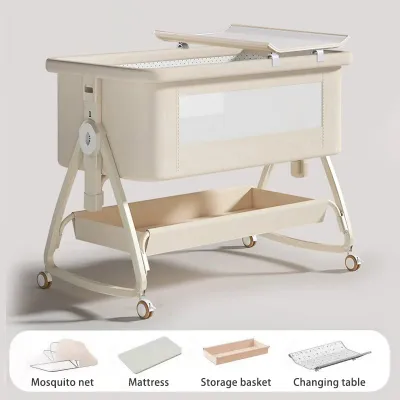

Prices are valid at publication and may change. Please refer to the product page for the latest price.
Next, measure the height of your adult mattress from the floor. Most co-sleepers offer adjustable height settings, but they still have a strict minimum and maximum range. The top edge of the co-sleeper’s lowered side barrier must align precisely with the top surface of your adult mattress. If your bed sits on an ultra-low platform or an exceptionally high custom frame, the co-sleeper may not be able to reach a flush position. Never attempt to prop up the co-sleeper legs with books, wooden blocks, or DIY risers, as this compromises the structural integrity of the unit.
The firmness of your adult mattress is another critical factor that is often overlooked. If you sleep on a soft, memory foam, or thick pillow-top mattress, it will compress significantly when you lie down. This compression creates a slope or a deep depression next to the co-sleeper, which can cause your baby to roll toward you or become wedged in the resulting gap. For a co-sleeper to function safely, the adult mattress must be firm enough to maintain its shape and height even when supporting your weight.
Finally, assess your baby’s current physical development and weight. Every co sleeper comes with strict maximum weight limits—often ranging between 9 to 11 kilograms—and developmental milestones. If your baby is already showing signs of rolling over, pushing up on their hands and knees, or sitting up independently, they have outgrown the safe usage limits of a bedside sleeper. In these cases, you must bypass the co-sleeper entirely and opt for a standalone crib or a compliant floor bed to prevent fall hazards.
Step-by-Step Guide to Attaching the Co-Sleeper
Once you have confirmed compatibility, you can begin the physical assembly and attachment process. It is highly recommended to perform this setup during the day when you have plenty of light and are not rushed by a tired baby. Always have your specific product manual open and follow its illustrations step-by-step. If you find that the manufacturer’s instructions conflict with your bed setup, or if you cannot identify your bed type, stop immediately and consult the manufacturer or a qualified professional before proceeding.

Adjusting the Height for a Flush Fit
Begin by placing the assembled co-sleeper directly next to the side of your bed where it will remain. Locate the height adjustment mechanism on the legs of the co-sleeper, which usually consists of spring-loaded buttons, levers, or dial locks. Carefully adjust each leg so that the sleeping platform of the co-sleeper is level and the lowered side barrier is flush with the top surface of your adult mattress.
It is vital that both sides of the co-sleeper are set to the exact same height level. A tilted sleep surface can cause your baby to slide toward one end, increasing the risk of suffocation against the fabric walls. Once adjusted, double-check that the co-sleeper’s own mattress fits snugly within its frame. There should be no internal gaps between the mattress pad and the mesh sides of the bassinet. If the mattress slides around or leaves a gap wider than a finger, verify that it is placed correctly and that you are using the original mattress supplied by the manufacturer.
To ensure a perfect alignment, lay a long, flat object—such as a spirit level, a broomstick, or a sturdy wooden hanger—across both the adult mattress and the co-sleeper mattress. The object should lie completely flat without tilting up or down. If there is a noticeable step-down or step-up between the two surfaces, readjust the co-sleeper legs until the transition is completely seamless.
Securing the Units Together Safely
The most critical phase of the installation is physically locking the co-sleeper to your adult bed. Every compliant co sleeper comes with a set of heavy-duty safety straps or specialized anchor brackets. These straps are designed to wrap around your adult bed frame, box spring, or mattress to prevent the two beds from drifting apart during the night.
Feed the straps through the designated attachment points on the co-sleeper frame, strictly following the routing diagram provided in your manual. Pass the long ends of the straps under your adult mattress, wrapping them securely around the opposite side of the bed frame or box spring. If you have a slatted bed frame, ensure the straps are anchored to a structural wooden or metal rail rather than loose slats. Never simply tuck the straps under the mattress without securing them to a solid anchor point, as friction alone will not hold the unit in place.
Once the straps are properly routed, pull them tight with significant force. The co-sleeper must be pulled flush against the side of your adult mattress, compressing the foam or fabric slightly to create a tight, seamless seal. Lock the buckles or tension clips securely. Give the co-sleeper a firm tug to ensure the straps do not slip or loosen under pressure. Any excess strap length should be rolled up and secured with the provided Velcro tabs or tucked safely out of reach under the bed to eliminate tripping or strangulation hazards.
Eliminating Gaps and Hazards: The Post-Installation Safety Check
Even after a careful installation, you must conduct a thorough safety inspection before placing your baby in the co-sleeper for the first time. This post-installation check acts as your final defense against entrapment and suffocation risks.
Start by performing a physical gap check along the entire boundary where the co-sleeper meets your adult bed. Slide your hand along the seam between the two mattresses. There must be absolutely no space, gap, or soft crevice between them. If you can insert two fingers or see a visible opening, the setup is highly dangerous. A baby can easily wiggle into this gap, leading to positional asphyxiation. If a gap exists, loosen the straps, reposition the co-sleeper, and retighten the system until the gap is completely eliminated.
Next, test the overall stability of the setup. Place your hands inside the co-sleeper and apply moderate downward and outward pressure, simulating the movement of an adult shifting in bed or a baby pressing against the sides. The co-sleeper should remain rock-solid and must not tilt, slide, or sway away from the adult bed. In the humid tropical climate of the Philippines, fabric straps and plastic buckles can occasionally stretch or degrade over time. Make it a habit to perform this stability check every single night before bedtime.
If your co-sleeper has a retractable or drop-down side wall, verify its locking mechanism. When attached to your bed, this wall must be fully lowered and locked into its designated open position. It should never be left halfway up or unsecured, as loose fabric or partially collapsed bars can pose a strangulation hazard. Conversely, if you ever move the co-sleeper away from your bed to use it as a standalone bassinet, you must fully raise and lock the side wall to prevent your baby from rolling out.
Establish a strict stop-use condition for your nursery setup. If you cannot completely eliminate a gap between the mattresses, if your adult bed frame prevents the safety straps from anchoring securely, or if the co-sleeper feels unstable even after tightening, do not use the product. In such scenarios, immediately discontinue the setup and consult the manufacturer’s customer service or a qualified nursery specialist. Never attempt to resolve the issue with makeshift solutions like stuffing towels, pillows, or foam wedges into the gap, as these temporary fixes are major suffocation hazards.
Safe Sleep Rules and When to Transition Out
Having a perfectly installed co sleeper is only half the battle; maintaining a safe sleep environment inside the unit is equally vital for your baby’s well-being.
Keep the co-sleeper’s sleeping surface entirely bare. The only item that belongs in the bassinet is your baby, dressed in a snug-fitting swaddle or sleep sack suitable for the room temperature. Do not add pillows, thick blankets, bumper pads, stuffed animals, or sleep positioners. While it can be tempting to use soft bedding to make the space look cozy, these items significantly increase the risk of Sudden Infant Death Syndrome (SIDS) and suffocation. Always supervise your baby during sleep and ensure they are placed on their back.
You must also remain vigilant about your own bedding. Large adult pillows, heavy duvets, or loose sheets can easily migrate across the boundary into the co-sleeper while you sleep. To prevent this, keep your pillows centered on your bed and use lightweight, fitted blankets that are tucked securely at the foot of your mattress. If you prefer using a heavy comforter, ensure it is folded back away from the co-sleeper side so there is no chance of it draping over your baby’s sleep space.
Pay close attention to your baby’s growth and developmental milestones. Bedside co-sleepers are temporary sleeping solutions designed for the earliest stages of infancy. The moment your baby begins to roll over, push up on their hands and knees, or reach the manufacturer’s stated weight limit, you must transition them out of the co-sleeper immediately. Even if your baby is below the weight limit, their ability to move or roll means they can easily climb over the lowered barrier or tip the bassinet, presenting a severe fall risk.
When it is time to transition, move your baby to a full-sized standalone crib, a pack-and-play, or a safety-compliant floor bed. In the Philippines, high-quality wooden cribs or portable playards are widely available—typically ranging in price from ₱3,500 to over ₱12,000 at local baby specialty stores—and offer a much deeper, secure sleeping area that safely accommodates your growing baby’s movements.
Frequently Asked Questions (FAQ)
Can I use a co-sleeper on a bed with a soft or memory foam mattress?
No, using a co-sleeper with a soft or memory foam mattress is highly discouraged and often explicitly warned against by manufacturers. Soft mattresses compress deeply under an adult’s body weight, which can cause the adult bed surface to sink lower than the co-sleeper surface. This uneven compression creates a dangerous slope or a deep gap between the two mattresses, allowing your baby to roll into the crevice and face a high risk of suffocation. To use a co-sleeper safely, your adult mattress must be firm and capable of maintaining a level, flush alignment with the bassinet.
Is it safe to use a co-sleeper without the attachment straps if it is pushed against a wall?
No, it is never safe to omit the attachment straps, even if the co-sleeper is pushed tightly against a wall or heavy furniture. Throughout the night, the natural movements of an adult tossing and turning can easily cause the adult bed to shift slightly away from the co-sleeper. Without mechanical straps locking them together, even a tiny separation of a few centimeters can create an entrapment hazard. Mechanical fasteners, such as safety straps and anchor brackets, are the only reliable way to keep the co-sleeper locked securely to your bed and prevent dangerous gaps from forming.
Community discussion
Share your experience or ask a question. Comments are reviewed before publication.