
Adjusting your LilleBaby carrier correctly is the key to transitioning from carrying a delicate newborn to a curious, active older baby. While these premium carriers—which typically range from ₱6,000 to ₱11,000 in the Philippines—are designed to grow with your child, achieving a safe, ergonomic fit requires understanding how to adjust the seat width, head support, and strap system. In our warm, tropical climate, getting these adjustments right also ensures optimal airflow, preventing your baby from overheating during outdoor strolls or mall visits.
Whether you are using a LilleBaby Complete, Pursuit, or SeatMe model, the transition from carrying a newborn to an older baby involves distinct structural modifications. A newborn requires maximum physical support, a narrow seat base, and a fully secured headrest to protect their developing spine and airway. As your baby grows and develops independent head and neck control, you will need to widen the seat base and lower the head support to accommodate their expanding view of the world.
Pre-Use Safety Checks and Preparation
Before placing your baby into the carrier, perform a thorough physical inspection of the gear. Examine the fabric panels, shoulder straps, and waist belt for any signs of wear, such as frayed stitching, torn seams, or worn elastic loops. Test every plastic buckle, adjuster, and snap button to ensure they click securely into place and do not slip under tension. If you notice any structural damage or compromised fasteners, stop using the carrier immediately and contact the manufacturer for guidance.
Products mentioned in this guide
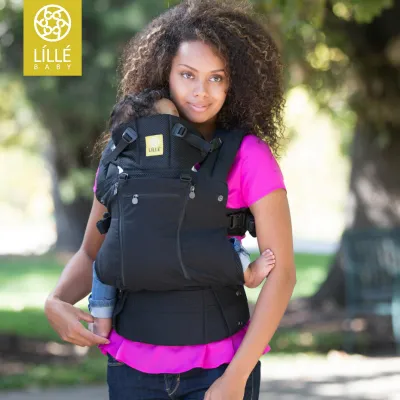
Prices are valid at publication and may change. Please refer to the product page for the latest price.
Always read the specific instruction manual for your exact LilleBaby model to verify its weight, height, and developmental limits. Different models have varying minimum weight thresholds, often starting around 7 pounds (approximately 3.2 kilograms) for newborns, and some may require a specific infant insert or a folded blanket adjustment depending on the manufacturing year and design. Never guess your baby’s current weight or assume suitability based on age alone; use a reliable scale to confirm they fall within the safe operating limits of your specific gear.
Babywearing safety relies on keeping your infant’s airway completely clear and unobstructed at all times. A newborn’s neck muscles are not strong enough to support their heavy head, making them vulnerable to positional asphyxiation if their chin drops toward their chest. Your adjustments must keep the baby’s face visible to you without any fabric, clothing, or carrier panels covering their mouth or nose.
Dressing your baby appropriately is crucial for safety and comfort, particularly in the humid climate of the Philippines. Because your body heat combines with the carrier’s fabric layers, a baby can quickly overheat. Dress your little one in a single layer of lightweight, breathable cotton or bamboo clothing, and avoid heavy onesies or footed sleepers that can pull tightly against their toes when their legs are positioned in the carrier. Monitor your baby’s temperature by feeling the back of their neck or chest; if they feel hot or sweaty, find a cool, shaded area or air-conditioned space to take a break.
Adjusting the Seat Width for Healthy Hip Positioning
The primary goal of adjusting the seat of your LilleBaby carrier is to support healthy hip development. The International Hip Dysplasia Institute emphasizes the importance of ergonomic positioning, where the baby’s hips are spread naturally to the sides with thighs supported and knees bent. This configuration keeps the hip joint in a secure socket, reducing the risk of developmental hip dysplasia.

Narrow Setting for Newborns
To configure the carrier for a newborn or small infant, you must adjust the seat base to its narrowest setting. On most LilleBaby models, this is achieved by unfastening the seat flaps from the waist belt, folding them inward toward the center, and securing them with the designated snaps or buttons. This adjustment narrows the fabric crotch piece so that it does not force a small baby’s legs to stretch too far apart, which could stress their delicate joints.
The narrow setting is designed specifically for newborns and smaller infants who fall within the manufacturer’s designated weight range for this position. Using a wide seat for a tiny baby can force their hips into an unnatural, overextended stretch. Always check your model’s manual to determine the exact weight threshold at which you must use the narrow configuration.
When your newborn is seated correctly in the narrow setting, the fabric should support them from the back of one knee to the back of the other. Their knees should rest slightly higher than their bottom, forming an ‘M’ shape when viewed from behind. Their lower legs must be free to move and bend at the knee, allowing them to kick naturally without the fabric cutting into their calves or forcing their legs to dangle straight down.
Wide Setting for Older Babies
As your baby grows, their thighs will lengthen, and the narrow seat will no longer provide adequate support from knee to knee. To transition to the wide seat setting, unfasten the seat flaps from their folded position and extend them outward along the waist belt, securing them firmly with the snaps or buttons as detailed in your manual. This widens the base of the carrier to accommodate your growing child’s longer legs.
The transition to the wide setting typically occurs when your baby can sit unassisted and their thighs have grown long enough to clear the wider fabric panel. Always cross-reference your baby’s physical measurements with the manufacturer’s size chart before making this change. If you transition to the wide setting too early, the fabric will push against the baby’s calves, forcing their knees straight and pulling their hips out of the correct ergonomic alignment.
In the wide setting, you must still maintain the ergonomic ‘M’ position. The expanded fabric base must support the baby’s thighs all the way to the knee crease, preventing their legs from dangling vertically. This knee-to-knee support distributes the baby’s weight evenly across their thighs and buttocks, reducing pressure on their spine and making the carry significantly more comfortable for both of you during longer outings.
Configuring the Head and Neck Support
Proper head and neck support is vital for protecting your baby’s airway and supporting their head before they develop muscular control. The headrest on a LilleBaby carrier can be raised, lowered, folded, or secured using a series of straps and buckles to match your child’s developmental stage.
Upright Support for Newborns
For newborns and young infants who lack independent neck control, the head support must be secured in its highest, most upright position. Fasten the headrest straps to the upper buckles on the shoulder straps, adjusting the tension so the panel stands vertically behind your baby’s head. This provides a stable barrier that prevents their head from wobbling backward or sideways as you walk.
While the support must be secure, it should never push your baby’s head forward so that their chin is pressed down toward their chest. The back of the head and neck should rest gently against the panel, maintaining a neutral spinal alignment. If the headrest is too tight, it can flex the baby’s neck forward, which can restrict their breathing.
To verify that the headrest is adjusted safely, use the two-finger rule. Gently place two of your fingers between your baby’s chin and their chest; you should be able to fit them comfortably without any resistance. If their chin is touching their chest or if there is not enough space for your fingers, loosen the headrest straps slightly and reposition your baby’s torso so their head is tilted slightly upward.
Folded or Lowered Support for Older Babies
Once your baby demonstrates full, independent head and neck control—typically around four to six months of age—you can fold down or lower the head support. Unbuckle the headrest from the shoulder straps, fold or roll the fabric downward, and secure it using the designated buttons or loops on the front of the carrier. This opens up the baby’s field of view, allowing them to look around and engage with their environment.
Depending on your specific LilleBaby model, the folded head support can serve multiple purposes. It can act as a supportive collar at the base of your baby’s neck, or it can house an integrated sleep and sun hood. In the sunny, high-UV conditions of the Philippines, using the sun hood can protect your baby’s sensitive skin from direct sunlight, but you must ensure it is adjusted loosely enough to allow fresh air to circulate freely around their face.
When folding the headrest, verify that the material does not bunch up uncomfortably behind your baby’s neck or push their upper back away from the carrier panel. The folded fabric should sit flat and secure, allowing your baby to turn their head from side to side without restriction. If the folded material feels too bulky, consult your instruction manual to check if your model allows the headrest to be completely removed or tucked into a dedicated pocket.
Fitting the Shoulder Straps and Waist Belt for Caregiver Comfort
A correctly adjusted carrier is just as important for the caregiver’s physical comfort as it is for the baby’s safety. Properly distributing your baby’s weight prevents shoulder strain, upper back tension, and lower back pain, allowing you to carry your child comfortably for longer periods.
Position the waist belt high on your torso, resting on your natural waist rather than down on your hips. Secure the buckle and pull the webbing tight so the belt fits snugly and flat against your body. Placing the waist belt higher transfers the majority of your baby’s weight to your hips and legs, which are much better suited for carrying loads than your shoulders and lower back.
Next, adjust the shoulder straps to your preferred configuration. Most LilleBaby carriers allow you to wear the straps in either a parallel (H-style) or crossed (X-style) formation. The H-style uses a chest strap to keep the shoulder pads from slipping, while the X-style crosses the straps over your back, which many caregivers find distributes weight more evenly across their shoulders and upper back. Experiment with both configurations to determine which style feels most supportive for your body shape.
Tighten the shoulder strap webbing so that your baby is held snugly against your chest. There should be no gap between your baby’s torso and your body; if you lean forward slightly, your baby should not slump or pull away from you. A loose carrier forces your back muscles to work overtime to maintain balance, leading to fatigue and increasing the risk of the baby shifting into an unsafe, curled position.
Verify the height of the carry using the ‘close enough to kiss’ test. With the waist belt and shoulder straps fully adjusted, you should be able to easily tilt your head forward and kiss the very top of your baby’s head. If you have to strain your neck downward or if your chin cannot reach their head, the carrier is riding too low. Loosen the shoulder straps slightly, slide the waist belt higher up on your torso, retighten the belt, and then pull the shoulder straps snug again.
Final Verification: The TICKS Safety Check
Before you begin walking or performing daily activities, always perform a final visual and physical safety check. The universally recognized TICKS acronym is an easy-to-remember tool that helps ensure your baby is safely positioned and secure every single time you wear them.
- T – Tight: The carrier must be adjusted snugly enough to hug your baby close to your body. Any loose fabric or slack in the straps can allow your baby to slump down, which can restrict their breathing and strain your back.
- I – In view at all times: You must always be able to see your baby's face simply by looking down. The fabric of the carrier, your clothing, or any accessories should never cover their eyes, nose, or mouth.
- C – Close enough to kiss: Your baby's head should be positioned high up on your chest, close to your chin. If you bend your head forward, you should be able to easily kiss the top of their head or forehead.
- K – Keep chin off the chest: Ensure there is always a gap of at least one finger-width (ideally two) under your baby's chin. Their head should be slightly tilted back to keep their airway fully open.
- S – Supported back: In an upright carry, your baby's back should be supported in its natural, gently curved position. Their tummy and chest should rest flat against your torso, ensuring they do not slouch or curl into a ball.
If at any point during your walk or activity you notice that your baby has shifted, slumped, or that any of the TICKS conditions are no longer met, stop immediately. Find a safe place to sit down, support your baby with your hands, loosen the necessary buckles, and readjust the carrier to restore a safe and ergonomic fit.
Frequently Asked Questions (FAQ)
When can I switch my baby to the forward-facing position?
You can transition your baby to the forward-facing position only after they have developed full, independent head and neck control, and are physically large enough to sit unassisted. This milestone typically occurs around six months of age, but you must consult your specific LilleBaby manual to verify the exact minimum weight and height requirements for your model.
When using the forward-facing position, you must adjust the seat base back to the narrow setting so that your baby’s legs can hang forward comfortably without their hips being forced into an unnatural stretch. Keep forward-facing sessions short—usually limited to 15 to 20 minutes—to prevent sensory overload, as facing outward exposes your baby to a high volume of visual and auditory stimulation.
Never allow your baby to sleep in the forward-facing position. If your baby shows signs of sleepiness or falls asleep, their head will drop forward, which can severely compromise their airway. You must immediately stop, remove them from the carrier, and transition them back to the parent-facing position where their head and neck can be fully supported by the raised headrest.
Community discussion
Share your experience or ask a question. Comments are reviewed before publication.