
Quick Answer: Which Shape Offers the Best Back Support?
Choosing the best pregnancy back pillow is not a matter of finding a single, universally perfect design. Instead, the ideal shape depends entirely on your personal sleep habits, your bed size, and the specific areas where you experience discomfort. There is no one-size-fits-all solution for maternal body changes, and each pillow shape serves a distinct structural purpose.
For restless sleepers who frequently toss and turn, a U-shaped pillow offers the most comprehensive dual-sided back and belly support without requiring you to reposition the cushion. If you prefer a full-body contouring experience that cradles your head, spine, and knees on one side without completely overtaking your mattress, a C-shaped pillow is an excellent middle-ground option. Meanwhile, a wedge pillow provides highly targeted, firm lumbar or belly support in a compact, portable format that is perfect for smaller beds or daytime seating.
Ultimately, selecting a pregnancy back pillow requires balancing your physical support needs with the practical constraints of your sleeping environment. By matching the pillow’s structural design to your sleep posture, you can significantly alleviate the muscular strain of pregnancy and enjoy more restful, restorative sleep.
Products mentioned in this guide
Prices are valid at publication and may change. Please refer to the product page for the latest price.
How Pregnancy Pillows Target Back Pain and Sleep Posture
During pregnancy, your body undergoes profound anatomical changes that directly impact your musculoskeletal system. As your baby bump grows, your center of gravity shifts forward. To compensate for this anterior weight, the lower spine naturally curves inward more dramatically, a condition known as lumbar lordosis. This shift puts immense strain on the surrounding muscles, ligaments, and the sacroiliac joints of the pelvis. Compounding this physical strain is the hormone relaxin, which loosens your ligaments to prepare your pelvis for birth but also makes your spinal alignment more vulnerable to poor posture.

Medical professionals strongly recommend side-sleeping during the second and third trimesters, with a particular preference for the left side. This position keeps the heavy uterus from compressing the inferior vena cava, the large vein that returns blood to your heart from your lower body, thereby optimizing blood circulation and oxygen delivery to the placenta. However, sleeping on your side for consecutive hours presents its own challenges. Without proper support, your upper leg tends to slide forward and rest on the mattress, which twists your pelvis and rotates your lower spine, leading to morning backaches and hip pain.
This is where a dedicated pregnancy back pillow becomes essential. Rather than simply acting as a soft cushion, a high-quality pregnancy pillow fills the physical gaps between your body and the mattress. By supporting the natural curves of your waist, back, and knees, it maintains a neutral spinal alignment and prevents pelvic twisting. It reduces the mechanical torque on your lower back, allowing your muscles to fully relax and recover while you sleep.
C-Shaped Pillows: Full-Body Contouring for Side Sleepers
A C-shaped pregnancy pillow features a continuous, curved design that resembles the letter C. It is engineered to offer seamless, single-sided support from your head down to your ankles. When using a C-shaped pillow, you place your back against the long, vertical spine of the “C” while tucking the upper curve under your head and the lower curve between your knees. This configuration provides a firm, reassuring barrier along your spine, which helps prevent you from rolling backward onto your flat back during the night.
The primary benefit of the C-shaped design is its ability to align the entire body simultaneously. By placing the lower hook of the pillow between your knees, your hips remain stacked and level, which directly reduces pressure on the pelvic girdle and lower back. Because it is a single, integrated unit, it eliminates the need for multiple loose pillows that can slide around and disrupt your sleep.
However, the C-shaped pillow has a notable limitation: its asymmetrical layout. If you prefer to switch sides during the night, you cannot simply turn over. You must either physically flip the entire bulky pillow to face the opposite direction or turn your body to face the open side of the “C,” which leaves your back without its primary support structure. This manual adjustment can be disruptive to your sleep cycle.
In terms of bed space, the C-shaped pillow is a moderate option. It is typically less bulky than a U-shaped alternative, making it suitable for queen-sized mattresses where you still need to share space with a sleeping partner. It offers full-body cradling without completely dominating the bed.
U-Shaped Pillows: Maximum Support for Restless Sleepers
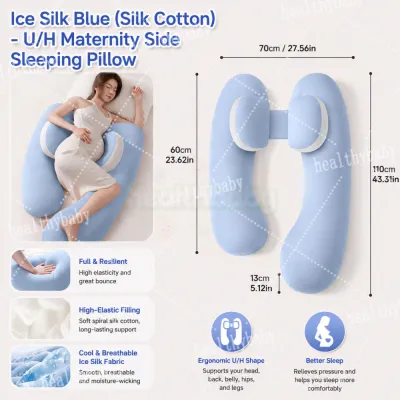
The U-shaped pregnancy pillow is the largest and most comprehensive support option available. It consists of two long, parallel arms connected at the top by a curved headrest. You sleep directly in the center of the “U,” which allows you to experience symmetrical, dual-sided support. One arm of the pillow cradles your back, while the other supports your growing belly and can be gripped between your knees.
This dual-sided architecture is incredibly beneficial for restless sleepers. If you frequently turn from your left side to your right side throughout the night, the U-shaped pillow requires zero manual adjustment. You simply rotate within the center of the pillow, and the opposite arm immediately provides the necessary back or belly support. This seamless transition helps maintain deep sleep stages by minimizing nighttime awakenings.
Furthermore, the U-shaped design creates a secure, nested sensation that physically restricts your ability to roll onto your back. The firm back arm acts as a continuous bolster, keeping you safely positioned on your side. This symmetrical support also ensures that your spine and pelvis remain perfectly aligned regardless of which direction you face, preventing any twisting or torque on your lower lumbar region.
The most significant drawback of a U-shaped pillow is its massive footprint. These pillows occupy a substantial portion of a standard double or queen-sized bed, which can leave very little room for a sleeping partner. They can also make changing the bed sheets more labor-intensive. Additionally, the enclosed design can trap body heat, which may be uncomfortable in warm or humid climates unless the pillow is paired with a highly breathable cover.
Wedge Pillows: Targeted Relief for Lower Back and Bump
A wedge pregnancy pillow is a compact, firm, sloped cushion typically made of high-density polyurethane or memory foam. Unlike full-body pillows, the wedge does not attempt to support your entire frame at once. Instead, it is designed for highly localized, targeted application. You can slide the thin edge of the wedge under your belly to gently lift and support its weight, or place it directly behind your lower back to act as a firm lumbar prop that prevents you from rolling backward.
The greatest advantage of the wedge pillow is its versatility and minimal space requirement. Because it is small, it does not crowd your bed, making it the ideal choice for couples sharing smaller mattresses or for those who prefer to keep their sleeping environment uncluttered. It is also highly portable, fitting easily into travel luggage, and can be used to provide lumbar support on office chairs, car seats, or sofas during the day.
Financially, wedge pillows are highly accessible, with budget-friendly options widely available. In the Philippines, high-quality wedge pillows typically range from ₱300 to ₱800, making them a cost-effective entry point for pregnancy comfort compared to larger full-body models.
The primary limitation of a wedge pillow is that it cannot provide comprehensive, full-body alignment on its own. To keep your head, neck, hips, and knees properly positioned, you will need to supplement the wedge with your standard bed pillows. This requires a bit of manual arrangement each night to ensure your joints remain in a neutral line.
Feature Comparison: C-Shaped vs U-Shaped vs Wedge
To help you visualize how these three distinct shapes compare across key practical dimensions, refer to the summary below. This table highlights how each design performs regarding support, space, and portability.
| Pillow Shape | Best For | Back Support Type | Bed Space Required | Portability |
|---|---|---|---|---|
| C-Shaped | Side sleepers who want full-body alignment without extreme bulk | Continuous, single-sided spine support; prevents rolling back | Moderate; fits well on queen-sized beds | Low; bulky to pack or travel with |
| U-Shaped | Restless sleepers who toss and turn frequently | Symmetrical, dual-sided support; locks side-sleeping posture | High; occupies a large portion of the bed | Very Low; heavy and difficult to transport |
| Wedge | Budget-conscious users, travelers, and those with limited bed space | Targeted, firm lumbar support; prevents rolling back | Very Low; compact and unobtrusive | High; lightweight and travel-friendly |
When evaluating these options, consider your bedroom’s physical layout and your partner’s sleeping space alongside your personal comfort needs. A pillow that provides excellent physical support is only useful if it fits comfortably within your daily living routine.
Decision Guide: Which Pregnancy Back Pillow Should You Choose?
To make your final selection, match your specific sleeping habits, physical discomforts, and home environment to the following scenarios:
- Choose a U-Shaped Pillow if: You find yourself tossing and turning constantly, you have a spacious bed (such as a king or wide queen), you want a secure "cocooned" feeling, and you require simultaneous, dual-sided support for both your back and your belly without having to move your pillow at night.
- Choose a C-Shaped Pillow if: You are a dedicated side-sleeper who wants full-body alignment from head to toe, you want a physical barrier to block you from rolling onto your back, and you want to preserve some mattress space for your partner.
- Choose a Wedge Pillow if: You only need localized support for your lower back or under your belly, you share a smaller bed, you travel frequently, or you want a highly affordable and versatile support option that can transition to office chairs and sofas.
Verify First: Critical Checks Before You Buy
Before finalizing your purchase, there are several essential factors you must verify to ensure long-term comfort and hygiene:
- Cover Material and Breathability: In a tropical, humid climate like the Philippines, heat retention is a major comfort barrier. Carefully check the product specifications for the cover fabric. Opt for natural, highly breathable materials such as 100% cotton, bamboo-derived rayon, or specialized cooling knit fabrics. Avoid heavy polyester or thick velour covers, which trap body heat and can lead to uncomfortable night sweats.
- Removable and Washable Cover: Pregnancy pillows are subjected to daily sweat, skin oils, and potential spills. Ensure the pillow features a fully removable cover with a durable, recessed zipper that won't scratch your skin. Verify that the cover is machine-washable and can withstand frequent laundering.
- Firmness and Fill Type: If you choose a full-body pillow, check if the filling is adjustable (such as shredded memory foam or polyester fiberfill) or fixed. Adjustable fills allow you to unzip an inner liner and remove or add stuffing to customize the loft and firmness to your body's changing shape. For wedge pillows, look for high-density, supportive foam that won't flatten under the weight of your body.
- Safety Certifications: Always verify safety certifications on the product packaging or manufacturer documentation. Look for labels indicating that the foam or fiberfill is free from harmful chemical emissions, heavy metals, and flame retardants (such as CertiPUR-US or OEKO-TEX Standard 100 certifications).
Disclaimer: If you experience severe, persistent back pain, or if your pain is accompanied by cramping, vaginal bleeding, fever, or difficulty urinating, stop using self-care measures immediately and consult your obstetrician or a qualified healthcare professional. A pregnancy pillow is a comfort aid designed to support healthy posture, not a medical treatment for underlying gestational complications.
Frequently Asked Questions (FAQ)
When is the best time to start using a pregnancy back pillow?
There is no strict calendar date to begin using a pregnancy back pillow, but most expectant mothers introduce one during the late first trimester or early second trimester (around weeks 12 to 16). This is typically when the abdomen begins to expand, making comfortable back-sleeping more difficult and putting initial strain on the lower back. Rather than waiting for a specific week, listen to your body’s signals; if you begin waking up with mild lower back stiffness, hip soreness, or find yourself struggling to stay comfortably on your side, it is time to start using a supportive pillow.
Can I combine a wedge pillow with regular bed pillows?
Yes, wedge pillows are specifically designed to be modular and work in tandem with your existing bedding. Because a wedge only provides localized support, you must pair it with a standard bed pillow to support your head and neck. For optimal spinal alignment, place the wedge under your belly or behind your lower back, use a supportive standard pillow under your head, and place another regular pillow between your knees. This combination helps keep your shoulders, spine, and hips in a straight, neutral line, mimicking the alignment of a full-body pillow without occupying the same massive amount of bed space.
Community discussion
Share your experience or ask a question. Comments are reviewed before publication.